雖然「鐘鳴風格」是皮亞爾特的標誌,但是他的創作並不僅限於此。早年的他曾經是蘇聯樂壇的「前衛分子」,用十二音、拼貼與實驗手法挑戰體制。移居西方後,他一方面深化簡約而靜默的語言,《柏林彌撒》(Berliner Messe);另一方面也展現出更多樣的風格:從大型宗教合唱作品《求主垂憐》(Miserere)、《懺悔加農曲》(Kanon Pokajanen),到具戲劇張力的管弦作品《哀歌》(Lamentate),甚至還有受建築或雕塑啟發的世俗樂曲《剪影》(Silhouette)、《獻給范艾克》(Für Jan van Eyck)。這些作品讓他在保持個人風格的同時,也能與不同藝術領域對話。
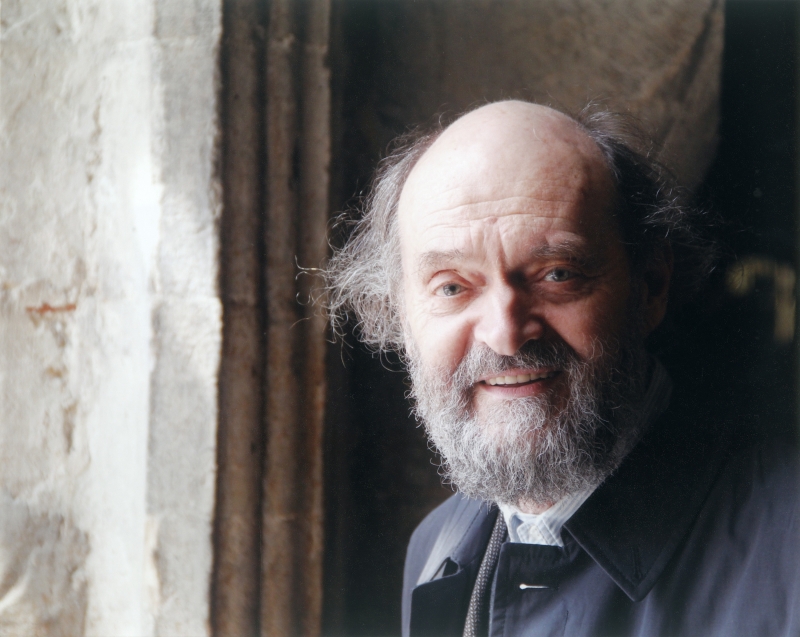
Composer Arvo Pärt celebrated his 90th birthday on September 11, 2025. Born in the small town of Paide in central Estonia, he was nearly fifty before he became known internationally, when ECM released the album "Tabula rasa" (1984). Until then, he had been a local composer known only in the Soviet Union. His earlier works, which combined atonal structures with experimental techniques, angered Soviet officials and forced him into a period of withdrawal, during which he turned deeply to the study of early music. Today, Pärt has opened a path of music defined not by dazzling compositional technique, but by simplicity, silence, and spirituality. He is now Estonia’s most famous composer.
Because there was an old grand piano at home, Pärt began piano lessons at the age of seven. But the middle register of the instrument was broken, so he could only play in the bass and treble. Looking back, he recalled sitting at that damaged piano, with deep resonance in the low register and breeze-like tones in the high, but always missing the middle connection. He tried to repair it himself, replacing hammers and tinkering with the mechanism, but the sound remained unstable. Curiously, this defect became a source of inspiration. He began to weave music out of the disjointed colors and fragmentary notes, as though repairing the instrument meant repairing his own soul. This limitation forced him to respond with creativity, moving between “reality and imagination” in search of new sounds and harmonies. “Combining reality with fantasy—perhaps this was the beginning of my minimalist style,” said Pärt.
In 1958, Pärt entered the Tallinn Conservatory and at the same time worked as a sound engineer at Estonian Radio. The job not only gave him financial support but also exposed him to practical sound technology. Yet one of his earliest large orchestral works, "Nekrolog" (1960), written using twelve-tone technique, was criticized by Soviet authorities. Later, his work "Credo" (1968), which combined Bach’s polyphony with modern collage techniques, was attacked for its supposed political implications. This pushed him into silence, and in 1980 he renounced his Soviet citizenship, emigrating with his family to Vienna and then Berlin, before finally returning to Estonia in 2010.
"Tabula rasa" marked his transition. After his creative silence in the early 1970s, Pärt studied medieval music and Gregorian chant, which led him to develop his "tintinnabuli" style. Its central principle is expressed in the formula 1+1=1—two lines, melodic and harmonic, becoming one indivisible whole. The sound resonates like bells, simple yet opening vast spiritual spaces. For Pärt, music is not decoration but an extension of prayer and breath. “I have discovered that it is enough when a single note is beautifully played. This one note, or a moment of silence, comforts me”.
"Tabula rasa" symbolized his “clean slate” approach to composition. Written in 1977 for violinists Gidon Kremer and Tatiana Grindenko, its rehearsals were tense: the players pored over the unfamiliar "tintinnabuli" score like explorers of an unknown map. “A drowning man will catch at a straw,” Pärt said later; he placed his hope in these musicians. Their profound understanding convinced him that the essence of music lies not in complexity but in the beauty of every single note. “It suffices to play every note beautifully,” he explained, recalling their success. The silence after its premiere, before the applause, confirmed for him that the work had found life.
In 1984, ECM’s release of "Tabula rasa" carried this conviction worldwide. With clear recording and a sound language both minimal and profound, Pärt became famous almost overnight. His idiom differed entirely from American minimalists like Steve Reich and Philip Glass, whose music focused on rhythm and energy. Pärt’s music was closer to meditation, an exploration of stillness. ECM’s founder Manfred Eicher provided an acoustic space of transparency and calm, giving listeners “a concentrated silence” that resonated far beyond the classical audience. Works such as "Für Alina" (1976), "Fratres" (1977), and "Spiegel im Spiegel" (1978) became widely loved.
"Für Alina" was his first "tintinnabuli" piece, a short piano work dedicated to a friend’s daughter. For Pärt, it recalled his childhood at the broken piano—few notes filling vast silences. The sustain pedal is essential so the notes ring like bells. To celebrate his 90th birthday, the Arvo Pärt Centre has launched a project inviting people worldwide to “Share your "Für Alina" story,” collecting memories of first encounters with the piece and how it touched lives.
By contrast, "Fratres" (Latin: “Brothers”), composed in 1977, exists in many versions. It reflects his "tintinnabuli" philosophy of 1+1=1, layering variations upon a repeating pattern with percussion interjections, symbolizing unity and brotherhood.
"Spiegel im Spiegel" (“Mirror in the Mirror”) conveys the image of infinite reflection. Originally for violin and piano, it has since been arranged for many instruments. The piano plays slow triads and scales while the violin unfolds a clear, lengthening melody, evoking endless space. Pärt called it a “breathing exercise”: every note must be in balance. Its calm, transparent sound has accompanied listeners through grief, memory, and healing.
Although "tintinnabuli" is his hallmark, Pärt’s oeuvre is broader. Early on he was an avant-garde rebel in the Soviet Union, using serialism, collage, and experiment. After moving West, he deepened his minimalist, meditative voice in works such as "Berliner Messe" (1990), but also wrote large sacred works like "Miserere" (1989) and "Kanon Pokajanen" (1997), the dramatic orchestral "Lamentate" (2002), and secular works inspired by art and architecture, such as "Silhouette" (2009) and "Für Jan van Eyck" (2020). These show his ability to remain true to his style while conversing with other artistic domains.
This September, Estonia marked the 90th birthday of its “most famous son” with nationwide celebrations—from Tallinn to Paide, with festivals, exhibitions, lectures, and conferences. Across Europe, major halls and choirs held concerts, with the BBC Proms featuring special programs; in Asia and the Americas, festivals highlighted his works as well. More than a birthday, it became a global gathering of minds and hearts around his music.
Throughout his life, Pärt has emphasized that music is not ornament but the extension of prayer and breath. At ninety, his works continue to kindle resonance worldwide. Perhaps when we listen quietly to those simple yet profound sounds, we are sharing a silence that transcends nations and time. At ninety, Arvo Pärt is still telling the deepest truths with the fewest notes.


 陳效真作品集
發表留言