此時,唯一的烏克蘭人卡拉比茨語氣開始有些激動:「我不斷問自己,這是為了什麼?這場戰爭的意義又是什麼?」「俄羅斯的『救世主們』摧毀烏克蘭很多城市,他們轟炸平民居住的地方,像是第聶伯(Dnipro)。他們每天開火,他們炸的不是軍事設施,而是診所、醫院、兒童遊樂場,以及那些普通的人⋯⋯」正當卡拉比茨講出「俄羅斯的『救世主們』」時,普雷特涅夫默默插嘴更正他的用字:「是俄羅斯的半獸人」(the orcs of Russia)。
卡拉比茨出生於基輔,烏克蘭柴科夫斯基國家音樂學院(Ukrainian National Tchaikovsky Academy of Music)畢業後,一九九五年進入國立維也納音樂暨表演藝術大學(Universität für Musik und darstellende Kunst Wien),從此把事業重心放在歐洲。他的父親伊凡‧卡拉比茨(Ivan Karabits)是烏克蘭非常著名的作曲家與指揮家,出生於烏克蘭東部頓內茨州(Donetsk Oblast)的雅爾達(Yalta)。二○○四年,同樣位在頓內茨州的母校更名「巴赫穆特伊凡‧卡拉比茨藝術學校」(Бахмутський коледж мистецтв імені Івана Карабиця)以紀念兩年前逝世的伊凡‧卡拉比茨。
卡拉比茨突然把焦點轉向另一個讓他深感不安的問題,那就是文化,他談起一個政府機構:烏克蘭國家記憶研究所(Ukrainian Institute of National Memory)。這是隸屬於烏克蘭政府的中央行政機構,設立於二○○六年,但是二○一四年推翻親俄總統亞努科維奇(Viktor Yanukovych)後,它不但重新活躍而且職權擴大,積極主導「去俄化」政策,從更名街道、移除雕像,一路延伸到文學與音樂教育領域。它不僅制定「什麼能讀、什麼能演」,甚至決定哪些文化人物在公共論述裡「可以被提及」。於是俄羅斯作曲家柴科夫斯基、穆索斯基、葛令卡的作品不准演出或是移出教材;文學家果戈里(Nikolay Gogol)的作品自中學課程中刪除;普希金(Alexander Pushkin)雕像或是街名被拆除或改名⋯⋯他們把「去俄化」被視為文化安全的一部分,認為烏克蘭必須切斷俄羅斯文化支配,重建民族歷史與認同。
文化禁令不只發生在烏克蘭。普雷特涅夫也談到俄烏戰爭後,西方各地出現禁止演出蕭斯塔科維奇、包羅定等俄國作曲家作品的情況。他打趣地說:「我們就說拉赫曼尼諾夫是偉大的美國作曲家,應該就能安全上演了。」普雷特涅夫還提到俄羅斯國家管弦樂團(Russian National Orchestra, RNO)創團初期赴以色列演出時的經歷。當時以色列仍對華格納採取非正式的禁演態度,但是他故意在安可曲安排《羅安格林》第三幕前奏曲。出乎意料的是,聽眾反應極為熱烈。「可能他們不知道那是華格納,但是這首曲子真的很好。」這段經驗恰好說明:藝術作品本身不應成為政治情緒的犧牲品。文化禁令往往只是戰時民族主義的反射行為,而不是音樂本身的問題。
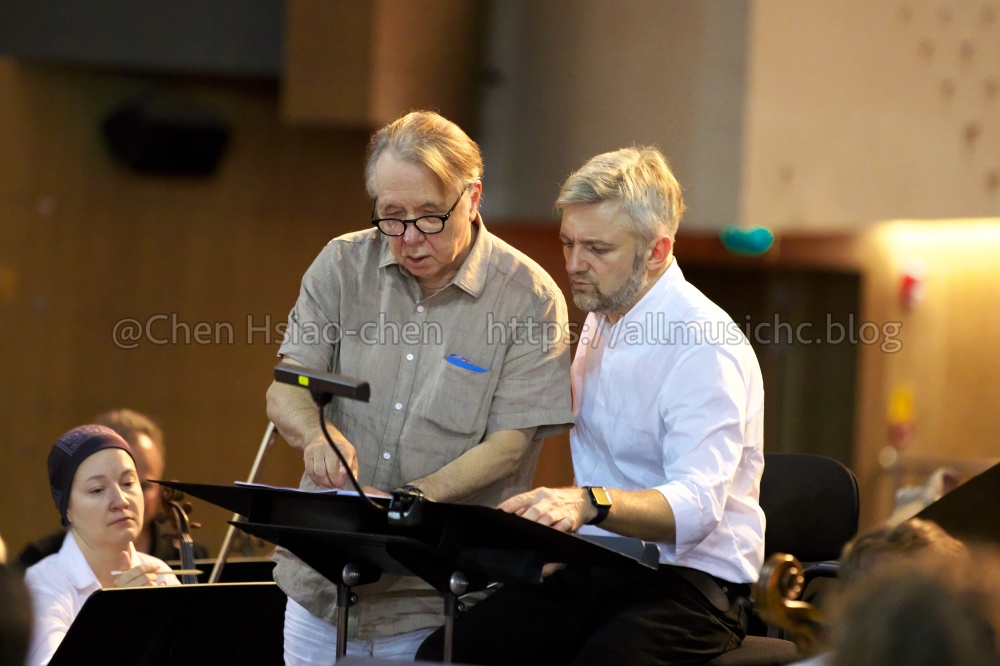
Mikhail Pletnev and Kirill Karabits. (photo: Chen Hsiao-chen)
After ten hours of rehearsal, I had a simple supper in a small restaurant with Mikhail Pletnev and Sergey Markov, the general manager of the Rachmaninoff International Orchestra (RIO). Perhaps the sound of Rachmaninoff’s music was still echoing faintly in our minds, or perhaps the earlier conversation with Markov had simply continued its quiet momentum; whatever the reason, the moment Pletnev sat down he began speaking about Rachmaninoff’s final orchestral work, "Symphonic Dances". He praised its scoring with characteristic fervour: “The orchestration is absolutely precise - every single voice is speaking.”

The talk drifted easily from music to the Tunguska event, and even to Elon Musk and Tesla, until the late-arriving conductor Kirill Karabits finally joined us. Only then did I realise that a Russian sat on my right and a Ukrainian on my left. The atmosphere shifted, almost imperceptibly; and, as though pulled by the gravity of the present moment, the conversation slid towards the war between Russia and Ukraine, and the wider political landscape it has unsettled.

“No one will win. Everyone will lose. Russia will not win, and Ukraine cannot win.”

It was Markov - formerly a diplomat, now living between Spain and Moscow - who first offered this verdict. At the beginning, he said, everyone had imagined the war might end in three days, or perhaps three weeks; the West believed that sanctions would cripple Russia’s economy within six months. “Everyone was wrong,” he continued, “because Europe will not allow Ukraine to lose, and China will not allow Russia to lose. And if Europe begins to lose, the United States will intervene.”

If there is no viable definition of victory, then this is a war in which neither side is permitted to lose - and thus one destined to have no obvious end.

At this point, the only Ukrainian at the table, Kirill Karabits, spoke with growing emotion.
“I keep asking myself - what is this for? What is the meaning of this war?”
He went on, “The so-called ‘saviours’ of Russia have destroyed so many Ukrainian cities. They bomb places where civilians live - Dnipro, for example. They fire every day. They bomb not military targets but clinics, hospitals, children’s playgrounds, ordinary people…”

As he spoke of these “saviours”, Pletnev quietly corrected him, “The orcs of Russia”.

Karabits was born in Kyiv. After graduating from the Tchaikovsky National Music Academy of Ukraine, he entered the University of Music and Performing Arts in Vienna in 1995, establishing his career in Europe. His father, Ivan Karabits, was one of Ukraine’s most celebrated composers and conductors, born in Yalta in the Donetsk Oblast. In 2004, the arts college in Donetsk - his father’s alma mater - was renamed the Bakhmut Ivan Karabits College of Arts in honour of him.

Not only did the school bear his father’s name, it also housed a museum devoted to him. “That place has profound meaning for our family, because it was where his musical life began,” Karabits said. “But now it has been taken by Russia. I can never return. What was all this for?”

Markov described Vladimir Putin as a man who had effectively “fed the whole of Russia a kind of hallucinogenic drug.”

“This drug makes you think you are strong, that the world fears you, that you can finish Ukraine in three days. That is what the drug does - it lets you live inside an illusion.” Then he added, “But when the drug wears off, you wake with a terrible headache, realise you’ve spent all your money buying the narcotic, your friends have gone, and only one thing remains: you must go back and work - twice as hard, properly and honestly.”

If the war has any positive consequence, he suggested, it lies in stretching this fantasy to breaking point, forcing Russians to wake from their dream and recognise, perhaps for the first time, that they are not as powerful as they imagined.

Quite suddenly, Karabits steered the conversation toward another concern of his - culture. He spoke of the Ukrainian Institute of National Memory, a government body established in 2006 and significantly empowered after the fall of Yanukovych in 2014. It has played a central role in Ukraine’s de-Russification policies, ranging from the renaming of streets and the removal of monuments to shaping literature and music education. It determines “what may be read and what may be performed,” and even which cultural figures may be mentioned in public discourse. Thus, works by Tchaikovsky, Mussorgsky and Glinka have been removed from curricula or prohibited in performance; the writings of Nikolay Gogol have been taken out of school programmes; statues of Alexander Pushkin have been torn down or renamed. De-Russification, he noted, is regarded as part of cultural security - an attempt to break from Russian influence and restore a distinct national identity.

But such power unsettles him. Karabits said plainly that he could not accept a single government institution deciding the value of culture. Mussorgsky composed many works on Ukrainian themes; Gogol, born in present-day Poltava, drew deeply from Ukrainian folklore - yet both are excluded simply because they wrote in Russian. The policy, he felt, severs Ukraine’s own cultural threads, diminishes its depth, and reduces art to an instrument of ideology.

Nor are cultural bans limited to Ukraine. Pletnev noted that, following the outbreak of war, many Western institutions cancelled performances of Shostakovich, Borodin and other Russian composers. He joked, “We can simply say that Rachmaninoff is a great American composer, and we will be allowed to perform him safely.”

He recalled the early days of the Russian National Orchestra, when they toured Israel at a time when Wagner remained unofficially banned. For the encore, he deliberately conducted the Prelude to Act III of "Lohengrin". To his surprise, the audience responded with great enthusiasm. “Perhaps they did not know it was Wagner - but the music is beautiful.”
Such moments reveal that art should not become the casualty of political moods; cultural prohibitions are often merely reflexes of wartime nationalism, not assessments of artistic worth.

As he reflected on culture and politics, another figure came to Pletnev’s mind - Mikhail Gorbachev, the only Soviet or Russian leader he truly respected. “He was a man of great cultural refinement,” Pletnev recalled. “When I gave him our recording of Tchaikovsky’s Sixth Symphony, he said: ‘This music is so beautiful. When we were young, we used to cry listening to it.’”
Their final conversation took place after the Soviet Union had collapsed. Pletnev told him: “I felt sad"not because the Soviet Union had been divided into fifteen countries, but because it had not been divided into one hundred and fifty. If those regions had become small, normal nations with their own presidents and elections, no one would ever again control such a vast empire.”

He offered the example of Yakutia, Russia’s largest federal subject, comparable in size to India and rich in natural resources - wildlife, forests and minerals. “In theory, they could be wealthy,” he said, “but all the money flows to the pockets of Moscow’s oligarchs. The local people live like livestock - worse than livestock.”

It recalled for me a conversation from years ago, when Pletnev made much the same point and turned, quite unexpectedly, to Plato’s "Republic": the ideal polis must remain within the range of human sight for governance to be effective; once a state grows beyond what a community can sustain, it inevitably becomes monstrous.

On the future of Russia, Pletnev was even more pessimistic. Even if the war ended, he said, good days would not quickly follow. “Russian society will face infighting among patriots; criminals released for the ‘special military operation’ will clash with ordinary citizens. It will take decades to dismantle the old system. I will not live to be a hundred, so I will never see Russia’s good days.” Yet he added, almost gently, “Even so, the outcome is already clear. Russia has already lost.”

The gravity and candour of that supper made the small restaurant feel like a mirror, reflecting each person’s homeland, wounds and convictions. And yet it was precisely these fractures that made RIO’s existence feel all the more improbable and precious. What made that evening unforgettable was how clearly it revealed RIO’s essence: within this orchestra, Russians and Ukrainians perform side by side; beyond the music, each carries the weight of displacement, cultural rupture and political uncertainty.

And the following day, they still returned to the same stage, opened the same scores, and played the same music. This cannot solve the world’s problems, but it does show one thing: in an age of fragmentation, RIO continues to safeguard what we still hold in common, binding it - quietly yet resolutely - through music.


 陳效真作品集
發表留言