兩位鋼琴家的合作並非刻意安排,而是音樂道路上的自然交會。多年前,沙馬尤曾經因為手部問題向比利時鋼琴家提耶日(Jacques de Tiège)求助,而這位鋼琴家也正是安涅斯的老師。後來,安涅斯聽到沙馬尤為Erato錄製的舒伯特鋼琴獨奏專輯,對他的詮釋方式產生共鳴,於是二○一六年在挪威創辦羅森達爾室內樂音樂節(Rosendal Chamber Music Festival)時,邀請沙馬尤共同演出F小調幻想曲D. 940。後來兩人都形容那次合作經驗為「自然且動人」,也成為日後持續合作的起點。
In the world of the piano, four-hand playing has always occupied a marginal yet crucial position. It is neither solo piano nor music for two pianos. Instead, two performers must share a single instrument—keyboard and pedals alike—requiring each to relinquish full control and to learn how to listen to, and coordinate with, the other. This form of music-making, often described as “one keyboard, two performers”, did not fully take shape until the latter half of the eighteenth century. In 1777, the English music historian and composer Charles Burney published Four Sonatas or Duets for Two Performers on One Keyboard Instrument, marking the first time four-hand music appeared as a notated, practicable genre. This laid the groundwork for Mozart and Schubert, who would later elevate it to an artistic peak.
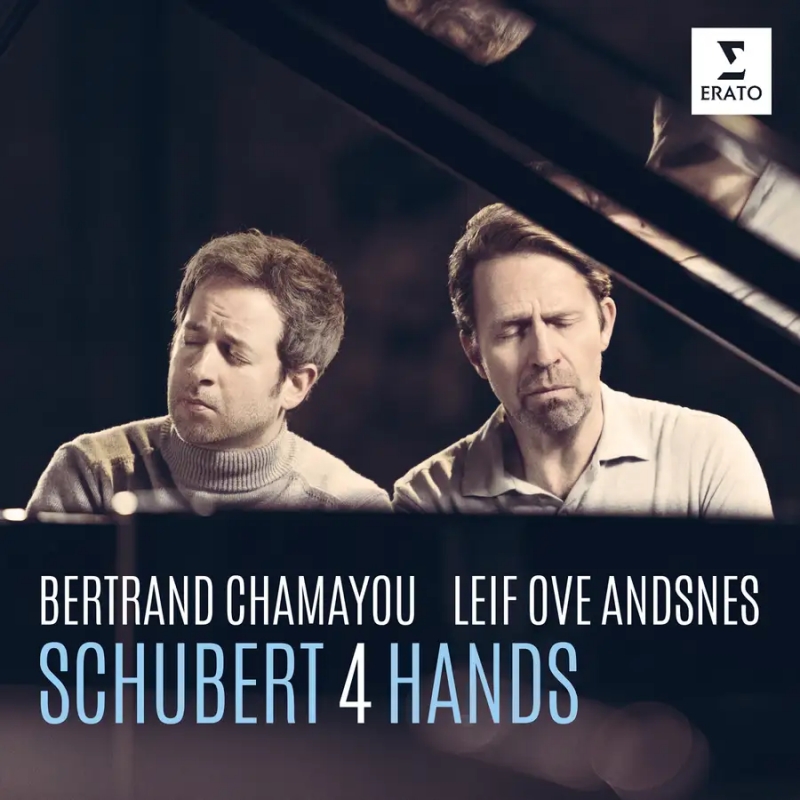
Schubert: Four Hands, recorded by the Norwegian pianist Leif Ove Andsnes and the French pianist Bertrand Chamayou, is an album conceived precisely around this idea of “two piano soloists sharing a single instrument and its control”. The programme centres on Schubert’s four-hand works from 1828, the final year of his life: the Fantasia in F minor, D.940; the Allegro in A minor, D.947 (Lebensstürme); the Fugue in E minor, D.952; and the Rondo in A major, D.951. By focusing on this decisive late period, the album invites listeners to explore Schubert’s creative state of mind at the very end of his life—a world of heightened tension and extraordinary refinement.
Posterity has often cast this year in a romantic glow, as if each work were written under the shadow of impending death. Andsnes and Chamayou both resist this view. They argue that Schubert may not have been aware that he was nearing the end, noting that in this very year he sought instruction in counterpoint from the Austrian composer and theorist Simon Sechter—hardly the action of someone resigned to death. This context helps to clarify the direction of these works. Rather than a summing-up of life in emotional terms, they can be understood as the result of Schubert’s continuing exploration of how music might still be written. Multiple voices operate simultaneously; inner parts no longer serve merely as accompaniment but actively drive the music forward. His growing interest in fugue and counterpoint tightens the musical fabric and refines its structure. All of this suggests that Schubert was not withdrawing into introspection or simplification, but pressing on towards greater complexity and maturity.
For pianists long accustomed to the concert platform as soloists, four-hand playing is not simply an extension of solo technique but a process of re-learning. Andsnes describes how each performer controls only half of the keyboard and must recalibrate their approach to dynamics, touch, and timing within extremely limited physical space. Chamayou likens the experience to a string quartet: when playing the lower part, the right hand occupies the middle register, much like a violist, supporting structure while shaping colour; when taking the upper part, the left hand—no longer providing the bass foundation—assumes a role closer to that of a second violin. This redistribution of physical and musical roles forces pianists to abandon solo habits and rethink the music from a different perspective. Pedalling, usually controlled by the player responsible for the lower part, must serve both parts simultaneously rather than a single line. These factors make four-hand playing an intensely intimate and inherently fragile form of ensemble music, where the slightest misjudgement can disrupt the whole.
Beyond repertoire, the album also reflects the distinct Schubert experiences each pianist brings. Andsnes has long been immersed in Schubert’s piano sonatas and songs, developing a keen sensitivity to long-range musical flow and to the subtle interplay between voices. He has often cited Alfred Brendel’s description of the “sleepwalking” quality of Schubert’s music—the sense that truth is always close at hand yet never quite grasped. Consequently, Andsnes avoids overtly dramatic gestures in late Schubert, allowing the music to unfold naturally rather than forcing expressive effects.
Chamayou approaches Schubert differently. For him, Schubert has never been a composer who yields easily, and precisely for that reason he emphasises restraint and structural clarity. His solo experience has taught him that Schubert demands a careful balance between lyrical cantabile and architectural coherence—two impulses often in tension. Chamayou therefore favours steady tempo, clear voicing, and rational control of form, resisting emotional inflation or loss of focus. In the context of four-hand playing, this disciplined approach provides a reliable temporal framework and a clear ordering of voices, forming the stable foundation of the duo’s ensemble.
In this programme, the distribution of parts changes from work to work. Andsnes takes the upper part in the Fantasia in F minor and the Rondo in A major, while Chamayou assumes it in Lebensstürme and the Fugue in E minor. This arrangement is not designed to establish hierarchy, but to allow each pianist to alternate between melodic prominence, inner voices, and structural support. From the listener’s perspective, this rotation dissolves fixed notions of principal and subordinate parts, turning the music into a genuine dialogue. Their collaboration was not the result of deliberate planning but of a natural convergence of musical paths. Many years ago, Chamayou sought help for a hand problem from the Belgian pianist Jacques de Tiège, who also happened to be Andsnes’s teacher. Later, Andsnes heard Chamayou’s Schubert solo recording for Erato and felt a strong affinity with his approach. When Andsnes founded the Rosendal Chamber Music Festival in Norway in 2016, he invited Chamayou to perform the Fantasia in F minor, D.940. Both pianists later described that experience as “natural and deeply moving”, and it became the starting point of their continued collaboration.
In the recording studio, this musical rapport took the form of detailed practical coordination. Both pianists emphasise that recording four-hand music is not a simple preservation of a live performance, but a process of constant discussion and adjustment. Decisions about balance between parts, pedalling, and the relative priority of melody and structure require repeated experimentation. Each choice must accommodate both players’ musical ideas, technical considerations, and interpretative aims. For this reason, Schubert’s four-hand works emerge not as accumulations of emotion, but as conversations in sound. The album thus offers a way of understanding Schubert’s late style: within intricate polyphonic textures, the music becomes not a monologue, but a subtle, finely wrought, and profoundly human dialogue—less a meditation on endings than a reaching forward towards what might still lie ahead.
Schubert: Four Hands
Bertrand Chamayou (piano), Leif Ove Andsnes (piano)
May 2025, the Church of St Jude-on-the-Hill, Hampstead Garden Suburb, London NW11 7AH


 陳效真作品集
發表留言