
鋼琴是在「講話」還是「發聲」?普雷特涅夫睽違二十年的黃標告白
多年前閱讀斯坦尼斯拉夫斯基(Konstantin Stanislavsky)自傳《我的藝術生活》時,有一段文字始終讓我難忘。一九一四年,年近五十歲、已經有豐富舞台與導演經驗的斯坦尼斯拉夫斯基在普希金詩劇《莫札特與薩利耶里》中扮演薩利耶里。他驚覺雖然能領略文字之美,說出口時卻顯得膚淺做作,於是開始研究如何讓聲音「像小提琴一樣發聲,而不像把豌豆撒在木板上那樣『敲』出字句」。最後他理解到一個真理:演員必須善於「講話」。
同樣的邏輯放在音樂界,我認為當今最能體現「講話」藝術的音樂家之一,莫過於普雷特涅夫(Mikhail Pletnev)。
生理本能:與生俱來的傾聽
普雷特涅夫對聲音的敏銳度似乎是與生俱來的。不到三歲的時候,當身為聲樂伴奏的母親把他放在鋼琴前時,他並沒有像一般幼童那樣,漫無目的以手掌拍打鍵盤,發出自覺反應的敲擊聲響。他不慌不忙,小心翼翼地以手指按壓琴鍵,並且傾聽那些聲音。對小普雷特涅夫來說,他感興趣的是琴弦的音色,而不是琴鍵敲擊的效果。
這種對聲響的細微敏銳度,曾經一度造成普雷特涅夫停止公開演奏鋼琴。關鍵理由之一,便是當時主流品牌鋼琴的設計與調整無法達到他理想中的聲音。為了適應大型音樂廳,現代鋼琴往往追求宏大的音量與動態,卻犧牲最弱音(Pianissimo)的細緻表現力。對於普雷特涅夫來說,這種樂器性能上的限制,對他而言無異於一種語言上的失語。
尋獲武器:重新定義工具
這種「語言的失語」,直到他遇見SHIGERU KAWAI SK-EX才得到補償。普雷特涅夫與河合樂器之間存在著一種近乎奢侈的默契:除了訂製專屬鋼琴,河合也承諾無論何時何地,都會由最頂尖的「大師級鋼琴技師」(Master Piano Artisan, MPA)團隊,把鋼琴完全調整成他想要的樣子。
法國鋼琴家康托羅夫(Alexandre Kantorow)曾經試彈過普雷特涅夫這部特製鋼琴,形容是自己彈過最奇特的鋼琴之一。除了觸鍵異常靈敏,還可以聽得出主人極度講究鋼琴音色,尤其是不同音域中的表現特性,像是低音必須柔和、高音必得明亮,從而達到一種歌唱般的音色效果,整體演奏感覺就像是融化的奶油般順滑。
普雷特涅夫這張新專輯的河合鋼琴技師藏田真也曾經在訪談中提到,為普雷特涅夫調校鋼琴不只要求物理上的精準,更是發自「五感的共振」。這種默契在本次錄音中發揮到了極致:藏田觀察到大師追求的是一種超越物理敲擊感的發聲方式,為了支撐這種美學,藏田必須在調律中確保鋼琴在極弱音(Pianissimo)範圍內,仍能保有豐富的層次與極長而穩定的餘韻。
藏田真也進一步解釋,由於錄音室環境極度安靜,且使用的是敏感度極高的復古磁帶錄音(詳見後文說明),任何機械構造的微小雜音都會被放至最大。為此,他對擊弦結構進行極其細膩的微調,旨在讓鋼琴擺脫金屬敲擊的生硬,轉化為能捕捉指尖最微小震動、具備呼吸感的靈敏載體。這種技術上的極致追求,正與普雷特涅夫對「聲音價值」接近病態的堅持合而為一。
修正遺憾:清算錄音室的「粗糙感」
然而,光有完美的樂器還不夠。對普雷特涅夫而言,如何捕捉自己理想中的發聲,始終是一場痛苦的拉鋸。他對自己過去的錄音評價極為嚴苛:「遺憾的是,我至今還沒做出好的錄音。在錄過的所有唱片裡,我最多只能挑出約四十分鐘讓我不覺得羞愧的零星片段,勉強湊成一張唱片⋯⋯我當初做了很多蠢事,現在,我想一切從頭開始重新錄製。」
這種對過往錄音的「自我厭惡」,重點在於他認為錄音技術往往會毀掉音樂的正確比例。他曾經詳細解釋:「在大音樂廳裡,我是為了整個大廳而彈。強音與弱音(尤其是弱音)的層次,必須調整到連最後一排的觀眾都能聽見。然而錄音室近在咫尺的麥克風不知道這一點,它只接收它聽到的聲音,結果往往變得非常粗糙,完全不是我想要的樣子。」雖然現場實況錄音可以捕捉當下的靈光,卻也無可避免麥克風與琴弦距離過近所產生的「粗糙感」。這也解釋了為何普雷特涅夫對二〇二四年五月在漢堡易北愛樂廳(Elbphilharmonie)的現場錄音不滿意,因為那種空間感被稀釋後的聲音,無法承載他想要對靈魂「耳語」的細膩度。
具體實踐:跨越三十年的考題
普雷特涅夫在二〇二四年十一月重返DG錄音室。這不僅是他自二〇〇五年六月錄製莫札特四首鋼琴奏鳴曲後首度回歸黃標,更補完錄音清單上的重要版圖。他曾經在一九九六年錄製過史克里亞賓二十四首前奏曲,但是在此之前從未正式留下蕭邦二十四首前奏曲的錄音。我一直覺得,這兩套前奏曲就像是普雷特涅夫每隔一段時間給自己出的階段性考題。早年他極少把蕭邦二十四首前奏曲排入獨奏會曲目,一九八九年第一次演出後,足足過了十五年才在二〇〇四年再次彈奏,隨後便決定不再公開演奏鋼琴。二〇一二年冬天重回鋼琴演奏舞台後,史克里亞賓的前奏曲就出現在非常前期的曲單,幾年後又排出蕭邦。如今決定走進錄音室。顯然是覺得現在握有能說出自己想說的話的武器,也就是那架能完全承載他音樂意志的鋼琴。
為了精準捕捉這種對音色的偏執,他選擇使用自一九八〇年代後便在黃標新片中絕跡的「純類比(AAA)」技術。透過Studer C37磁帶機與錄音師對空間比例的重新掌握,他試圖克服那種令他痛苦的「不完美」。整套錄音在短短四個半小時內一氣呵成,幾乎沒有多餘剪輯。而在正式錄製前的暖身中,普雷特涅夫彈奏各種腦中浮現的樂句,卻唯獨避開預定錄音的曲目。這種「放鬆的專注」,讓他能保持對曲目的新鮮感。類比磁帶保留了數位訊號難以複製的「呼吸頻率」,讓聽眾彷彿身處錄音現場,演奏普雷特涅夫所描述「上帝親手植入我魂靈裡的律動」。
蕭邦二十四首前奏曲,展現的正是在這架「完全意志鋼琴」的支撐下,普雷特涅夫對音樂結構的重新審視。在技術與感官刺激掛帥的當代,許多演奏家把鋼琴當作一種展示體能的「特技表演」。但對普雷特涅夫而言,演奏樂譜只是「基本任務」,而決定以什麼樣的心情、傳遞什麼樣的語言,才是「最高任務」。因此,他的蕭邦不再追求傳統觀念下的「爆發力」。在著名的第四號前奏曲中,他捨棄過往常見的濫情,以近乎透明的觸鍵讓音符呈現出一種「鬼魂般的存在感」。而在原本被視為展現能量的段落,如第十二、十六、十八號,他追求極其清晰的聲部對話。這種對聲音的極致要求,早在他二○○四年莫斯科音樂學院大音樂廳的演出中便有跡可循,當時聽眾竟屏息到「不忍心呼吸」。
與蕭邦遙相呼應的,是史克里亞賓二十四首前奏曲。普雷特涅夫對樂曲結構的掌握已到了隨心所欲的地步,他曾經驚人地在彈奏安可曲時把蕭邦第一號鋼琴協奏曲「倒著彈回去」。這種如建築師般對結構的絕對了解與主宰,讓普雷特涅夫在這次錄音中展現出一種超然的從容。他不再受制於樂譜的框架,轉而將全部心力投注於聲音的物理實驗:利用SK-EX柔韌的觸感,讓史克里亞賓的音符不再是被敲擊出的聲響,而是不斷在空氣中折射、渲染的光暈與色彩。
結語:潛入海底的先行者
回顧普雷特涅夫的藝術生涯,他始終是一個「絕世獨立」的存在。他不在乎當代的詮釋潮流,也不在乎是否符合聽眾對「俄羅斯學派」那種金石交擊聲響的刻板期待。他對學派的理解非常簡單:「就是聲音的價值、對聲音的態度⋯⋯以及美學的架構」。普雷特涅夫曾經把古典音樂形容成一望無際的大海,大部分音樂家都是挑選漂浮在海面上的素材,而他則是寧願「盡可能潛入海底,深入尋找不一樣的東西」。
當最後一首史克里亞賓D小調前奏曲落下,我感受到的不是技巧的震撼,而是一位智者在結束漫長談話後的長嘆。這張專輯帶給樂迷的,並不是又一次經典作品的彈奏,更是一段在紛擾世界中,與聽眾一次純粹、安靜且具備深度的「對話」。這段對話既優雅深刻,又邏輯嚴密,而我們,只需安靜地聆聽。(2026年5月12日)
Many years ago, while reading Konstantin Stanislavsky’s autobiography, My Life in Art (Моя жизнь в искусстве), one passage left an indelible impression on me. In 1914, the nearly fifty-year-old Stanislavsky, already a veteran actor and director, played Salieri in Pushkin’s verse drama Mozart and Salieri. He was struck by a sudden realisation: though he could appreciate the beauty of the words, they sounded superficial and affected when spoken. He began to study how to make the voice “sound like a violin, and not like peas being scattered on a wooden floor" (звучать скрипкой, а не «стучать» словами, точно рассыпаемым по доске горохом). Ultimately, he grasped a fundamental truth: an actor must excel at “speaking" (уметь «говорить»).
The same logic applies to the world of music. In my view, one of the musicians who most perfectly embodies this art of “speaking" today is Mikhail Pletnev.
Biological Instinct: A Born Listener
Pletnev’s sensitivity to sound appears to be innate. Before he was even three years old, when his mother, a vocal accompanist, placed him at the piano, he did not behave like an ordinary toddler, aimlessly banging the keys with his palms to produce instinctive percussive noises. Instead, calmly and deliberately, he pressed the keys with his fingers and listened to the sounds. For the young Pletnev, the interest lay in the timbre of the strings rather than the percussive effect of the keys.
This acute sensitivity to sound once led Pletnev to cease public piano performances. One crucial reason was that the design and regulation of mainstream pianos could not achieve his ideal sound. To suit large concert halls, modern pianos often pursue grand volume and dynamics, sacrificing the delicate expressive power of the pianissimo. For Pletnev, this limitation in instrument performance was nothing less than a linguistic aphasia.
Finding the Weapon: Redefining the Tool
This “linguistic aphasia" was finally remedied when he encountered the SHIGERU KAWAI SK-EX. A nearly luxurious understanding exists between Pletnev and Kawai: beyond providing a bespoke piano, Kawai promised that a team of top Master Piano Artisans (MPA) would adjust the instrument exactly to his wishes, wherever and whenever he performed.
The French pianist Alexandre Kantorow, who once tried Pletnev’s specially-tuned piano, described it as one of the most peculiar instruments he had ever played. Besides being exceptionally sensitive to the touch, it was evident that its owner was extremely fastidious about tonal quality—particularly the distinct characteristics across different registers. For instance, the bass had to be soft and the treble brilliant, achieving a cantabile effect. The overall playing sensation was as smooth as melted butter.
Shinya Kurata, the Kawai technician for Pletnev’s latest album, mentioned in an interview that regulating a piano for Pletnev requires more than physical precision; it stems from a “resonance of the five senses." This rapport reached its zenith during this recording. Kurata observed that the Maestro pursues a way of sounding that transcends physical percussion. To support this aesthetic, Kurata had to ensure that within the pianissimo range, the piano still possessed rich layers and a long, stable sustain.
Kurata further explained that because the studio environment is extremely quiet and sensitive vintage tape recording is used, any minute mechanical noise would be magnified. Therefore, he performed extremely delicate fine-tuning on the action, aiming to rid the piano of the hardness of metal percussion, transforming it into a sensitive medium capable of capturing the slightest vibration of the fingertips—an instrument with the capacity to breathe. This pursuit of technical perfection merges seamlessly with Pletnev’s almost pathological insistence on “tonal value."
Rectifying Regrets: Clearing the “Coarseness" of the Studio
Yet, a perfect instrument is not enough. For Pletnev, capturing his ideal sound has always been a painful struggle. He is ruthlessly critical of his past recordings: “Regrettably, I have yet to make a good recording. Out of all the discs I have made, I could at most pick out about forty minutes of scattered fragments that do not make me feel ashamed… I did a lot of stupid things (глупостей) back then; now, I want to record everything again from the beginning (записал все с самого начала)."
This “self-loathing" regarding past recordings stems from his belief that recording technology often ruins the correct proportions of music. He once explained in detail: “In a large hall, I play for the entire space. The layers of forte and piano—especially the piano—must be adjusted so that even the audience in the last row can hear. However, the microphone sitting inches away does not know this; it only receives what it hears, and the result is often very coarse (грубо), not at all what I want." Although live recordings can capture a spontaneous spark, they inevitably suffer from the “coarseness" caused by the proximity of the microphone to the strings. This explains why Pletnev was dissatisfied with the live recording at Hamburg’s Elbphilharmonie in May 2024; the sound, with its sense of space diluted, could not carry the delicacy of the “whisper" he wanted to deliver to the soul.
Practical Application: A Thirty-Year Exam
In November 2024, Pletnev returned to the DG studio. This was not only his first return to the Yellow Label since recording four Mozart sonatas in June 2005 but also the completion of a significant gap in his discography. Although he recorded Scriabin’s 24 Preludes in 1996, he had never formally recorded Chopin’s 24 Preludes. I have always felt that these two sets of preludes are like periodic exams Pletnev sets for himself. In his early years, he rarely programmed the Chopin preludes. After his first performance in 1989, fifteen years passed before he played them again in 2004, shortly before he decided to stop performing. Upon returning to the stage in the winter of 2012, the Scriabin preludes appeared very early in his programmes, followed a few years later by the Chopin. His decision to enter the studio now suggests he feels he finally possesses the weapon to say what he wants: a piano that can fully carry his musical will.
To capture this obsession with tone precisely, he chose “Pure Analogue" (AAA) technology, which has been absent from new Yellow Label releases since the 1980s. Through the use of Studer C37 tape machines and the engineers’ re-mastering of spatial proportions, he sought to overcome the “imperfection" that caused him such pain. The entire set was recorded in just four and a half hours in a single session, with almost no editing. During the warm-up before the formal recording, Pletnev played various phrases that came to mind, yet pointedly avoided the pieces scheduled for the session. This “relaxed concentration" allowed him to maintain a sense of freshness. Analogue tape preserves a “breathing frequency" difficult to replicate in digital signals, making the listener feel as though they are present in the room, hearing him play what he describes as “that which God has placed in my soul" (…играть то, что Бог вложил мне в душу).
Chopin’s 24 Preludes demonstrate Pletnev’s re-examination of musical structure, supported by this piano of “absolute will." In an era dominated by technique and sensory stimulation, many performers treat the piano as a “stunt" to display physical prowess. But for Pletnev, playing the score is merely the “basic task"; deciding what mood to convey and what language to transmit is the “ultimate task." Consequently, his Chopin no longer pursues “explosive power" in the traditional sense. In the famous Prelude No. 4, he discards the common sentimentality, using a nearly transparent touch to give the notes a “ghostly presence." In passages traditionally seen as displays of energy—such as Nos. 12, 16, and 18—he pursues exceptionally clear polyphonic dialogue. This extreme demand for sound was already evident in his 2004 performance at the Great Hall of the Moscow Conservatory, where the audience held their breath so intensely they “dared not breathe."
Echoing the Chopin are Scriabin’s 24 Preludes. Pletnev’s mastery of musical structure has reached a level of total spontaneity; he once remarkably performed Chopin’s Piano Concerto No. 1 “backwards" as an encore—starting from the finale and ending with the first movement. This architect-like understanding and command of structure allow Pletnev to exhibit a transcendent composure in this recording. No longer constrained by the framework of the score, he can devote his entire focus to a physical experiment in sound: utilising the supple touch of the SK-EX to ensure Scriabin’s notes are no longer percussive strikes, but halos of light and colour that constantly refract and diffuse through the air.
Epilogue: The Solitary Pioneer
Looking back at Pletnev’s artistic career, he has always been a solitary figure. He disregards contemporary trends of interpretation and remains indifferent to whether he fits the stereotype of the “Russian School" with its percussive, metallic sound. His understanding of a “school" is simple: “It is the value of sound, the attitude towards sound… and the aesthetic structure" (ценность звука, отношение к звуку… и эстетическая структура). Pletnev once likened classical music to a vast ocean. Most musicians choose the material floating on the surface, but he prefers to “dive as deep as possible, to look for something different deep below" (погружаться как можно глубже, искать там… что-то иное).
As the final Scriabin Prelude in D minor fades, what I feel is not the shock of technique, but the long sigh of a wise man ending a lengthy conversation. This album offers music lovers more than just another rendition of classic works; it is a dialogue—pure, quiet, and profound—within a turbulent world. This conversation is as elegant as it is logically rigorous, and we need only listen in silence. (12 May, 2026)
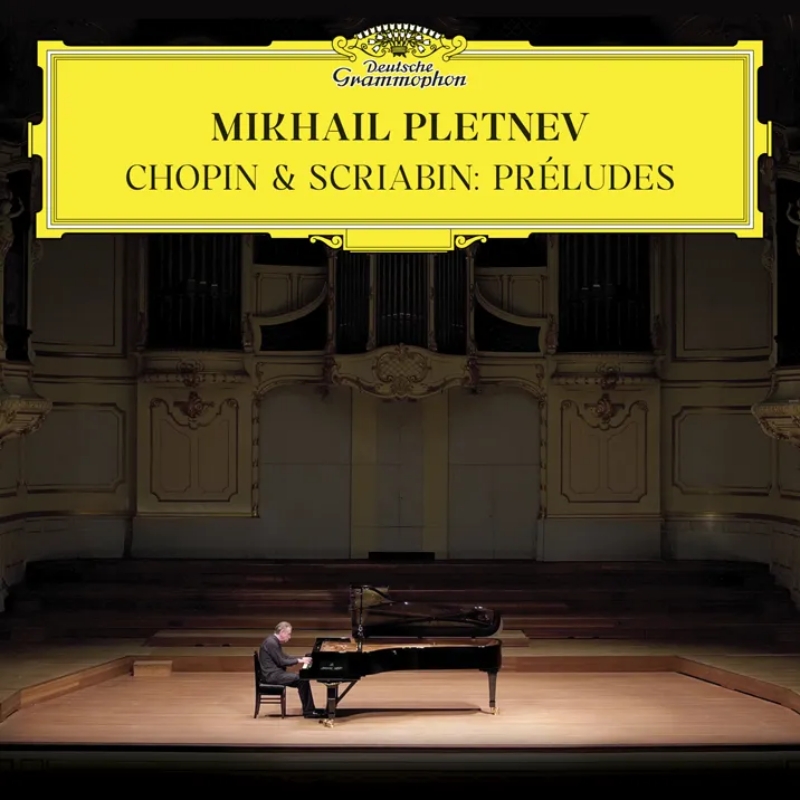
CHOPIN, SCRIABIN 24 Preludes
Mikhail Pletnev (piano)
November 2024, Emil Berliner Studios, Berlin


發表留言