這種熱情很快化為實際行動。一九七三年,還在皇家音樂學院(Royal Academy of Music)就讀的拉圖自行籌組樂團演出《復活》。由於校方不允許學生以正式身分指揮公開音樂會,他無法動用學校的交響樂團,只能四處邀集同學,逐步湊齊龐大的演出編制。這場演出不僅讓他受到樂壇注意,也促成他與經紀人坎貝懷(Martin Campbell-White)相識,開啟日後長達數十年的合作關係。
基於同樣的觀點,拉圖也不贊成把馬勒單純詮繹成感傷頹廢的作曲家。例如第五號交響曲第四樂章〈小慢板〉,長年受到電影《魂斷威尼斯》(Morte a Venezia)影響,因此常被演奏得極為緩慢。拉圖則認為,這段音樂更接近寫給艾瑪(Alma Mahler)的情書,而非死亡輓歌。根據與馬勒熟識的指揮家孟根堡(Willem Mengelberg)留下的筆記,這段音樂確實是馬勒向妻子表達愛意的作品。拉圖進一步指出,〈小慢板〉其實與終樂章緊密相連,兩者其實是同一段音樂旅程的延續。
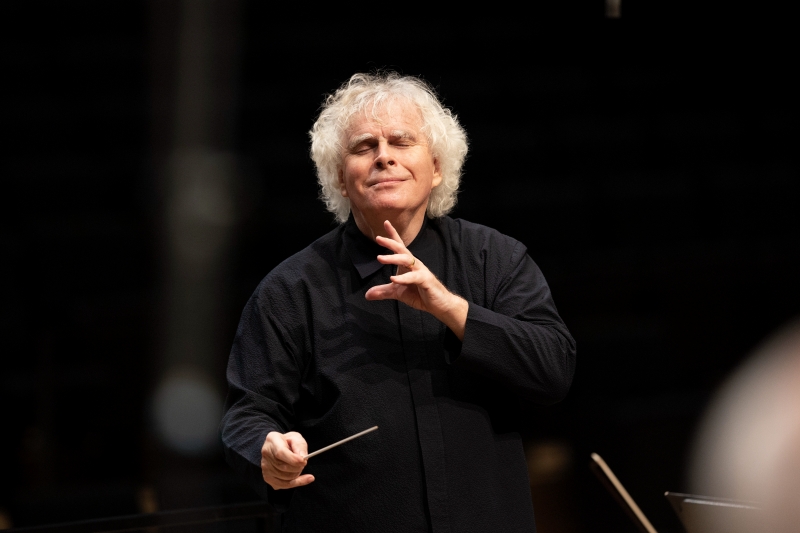
When discussing his relationship with Gustav Mahler, Sir Simon Rattle once employed an unromantic and rather striking metaphor: a virus.
In 1966, at the age of eleven, Rattle heard George Hurst conduct the Royal Liverpool Philharmonic Orchestra in Mahler’s Symphony No. 2, the Resurrection, in his hometown of Liverpool. At the time, Mahler’s music was still rarely performed in Britain, but that concert made a profound impression on him, marking the first moment he knew with certainty that he wanted to become a conductor. From that night on, Rattle described himself as having caught "an incurable Mahler virus".
This passion soon translated into action. In 1973, while still a student at the Royal Academy of Music, Rattle independently assembled an orchestra to perform the Resurrection. Because the Academy did not permit students to conduct public concerts in an official capacity, he could not use the school’s symphony orchestra; instead, he recruited fellow students one by one until the vast forces required were in place. The performance not only brought him to the attention of the musical world, but also led to his meeting with the artist manager Martin Campbell-White, initiating a partnership that would span several decades.
Perspective: A Musical Language Heading into the Future
Rattle has long maintained a view of Mahler distinct from that of the traditional Austro-German musical establishment: rather than the endpoint of nineteenth-century Romanticism, Mahler represents the starting point of twentieth-century music. Nowhere is this perspective more audible than in his unfinished Tenth Symphony. For many years, many musicians held reservations regarding posthumous performing realizations; Rattle, however, was deeply captivated by the piece from his youth and became one of the most vital champions of the performing version by the British musicologist Deryck Cooke and his colleagues. Rattle has conducted the work nearly a hundred times, leaving commercial recordings with the Bournemouth Symphony Orchestra in 1980 and the Berlin Philharmonic in 1999.
Although incomplete, Rattle maintains that the Tenth Symphony belongs entirely to Mahler, asserting that "we have every single bar". Beyond the first two and a half movements which Mahler managed to orchestrate, the remainder survives in an extraordinarily detailed short score, preserving the melodic line and musical structure intact. Rattle notes that much of late Mahler consists of "two lines or three lines with a lot of space in between them", meaning the music does not require filling up so much as "clothing". From the manuscript, he senses that Mahler worked in a distinct way, leaving "his whole line" so that posterity could synthesize the material. Crucially, the manuscript demonstrates that Mahler was moving towards a new musical language: Rattle points out that the first movement "seems to discover Berg", while the second movement prefigures the style of Paul Hindemith in the 1920s. For him, the Tenth Symphony proves that Mahler was not looking back, but exploring the future.
This outlook directly informed his programming. Upon assuming the post of Chief Conductor of the Berlin Philharmonic in 2002, Rattle paired Mahler’s Symphony No. 5 with contemporary composer Thomas Adès’s Asyla for his inaugural concert. He wanted the audience to hear directly that Mahler and contemporary music belong to the very same historical continuum, rather than two isolated worlds.
On similar grounds, Rattle rejects interpreting Mahler merely as a sentimental or decadent composer. For example, the Adagietto from the Fifth Symphony has long been performed at excessively broad tempos under the influence of the film Death in Venice. Rattle, however, views the movement as "Mahler's declaration of love for his wife Alma" — a love letter without words — rather than a funeral dirge. Annotations left by Willem Mengelberg, a conductor who knew Mahler intimately, confirm that the piece was indeed written as an expression of love for Alma. Rattle further notes that the Adagietto serves as the thematic foundation for the finale, making the two movements part of a single, continuous musical journey.
Metamorphosis: From Obsession with Detail to Fluidity
Yet Rattle’s understanding of Mahler was not born fully formed; it evolved over decades of performance experience.
During his tenure with the City of Birmingham Symphony Orchestra (CBSO), Rattle was renowned for his analytical acuity and rich attention to detail. He later acknowledged that his primary flaw as a young conductor was being overly absorbed in individual moments, which compromised the overarching momentum. This tendency attracted criticism at the time, with commentators suggesting that he over-managed localized nuances and timbres at the expense of a clear, unified architecture.
As he matured, Rattle gradually adjusted this approach. Comparing the role of a conductor to that of a judge, he remarked that with accumulated experience comes restraint — knowing when to intervene and when to step back and allow the music to unfold naturally. This shift became particularly marked from his later years in Berlin through to his tenure with the London Symphony Orchestra.
In 1991, following a triumphant live performance of Mahler’s Seventh Symphony with the CBSO, they entered the studio the following day, only to discover that while the execution was more precise, the indispensable spark of the live concert had vanished. Rattle accordingly refused to release the studio sessions, prompting EMI to record a live performance at Snape Maltings instead. This experience cemented Rattle’s belief that a recording is merely a snapshot of a single moment in time, rather than a work’s definitive statement.
By the time of his tenure with the London Symphony Orchestra, this philosophy had taken root even more deeply. In a single year, Rattle and the LSO performed Mahler’s Ninth Symphony sixteen times. While he initially feared such frequent repetition might cause the interpretation to harden into a set routine, the opposite occurred: the work revealed new facets with each successive performance. He came to believe that the objective is not to pursue a rigid, definitive reading, but to sustain the living vitality of the music.
Maturation: Stoic Acceptance and Fate's Reduction
In 2023, for his farewell concert with the London Symphony Orchestra at the BBC Proms, Rattle chose Mahler’s Symphony No. 9. He considers this work to be one that "makes the character of the performers, of the conductor and of the orchestra, visible like no other" — the ultimate touchstone of mutual trust and cohesion. More crucially, his interpretation had evolved from the conventional emphasis on death and farewell toward a stoic acceptance of life itself. He observed that the Ninth, while "completely haunted by death, is actually all about life". Though the music contains anguish and loss, it is not a sentimental swan song, but a serene, lucid, and loving acceptance. Choosing this vital work as a valediction marked a singularly mature culmination to his tenure with the orchestra.
As Chief Conductor of the Bavarian Radio Symphony Orchestra (BRSO), this mature perspective has become clearer still, as exemplified by his 2024 recording of the Sixth Symphony. In his youth, Rattle supported restoring the third hammer blow that Mahler had excised from the finale; later, however, he reverted to the two-blow edition. His decision to abandon the third blow began with a moment of superstition: the last time he attempted the three-blow version years ago, the percussionist accidentally missed the entry on stage. Rattle remarked with a smile that the universe seemed to be instructing him to honor Mahler's final instruction. On a deeper musical level, he realized that by the climax, the music has become so weakened that the tragedy is already complete; "just the return to A minor is necessary" to strike the fatal blow, requiring no physical hammer stroke to confirm fate’s arrival.
Conclusion: A Contemporary Voice Living in the Present
Tracing his trajectory from Birmingham and Berlin through London to Bavaria reveals a clear evolution in Rattle’s perspective on Mahler. As a young conductor, he was fascinated by analytical precision, structural detail, and proving Mahler’s modernity; over time, he turned his focus toward the organic flow and vitality of the music, growing ever more receptive to its inherent ambiguities.
Yet one element has remained steadfast. Ever since hearing the Resurrection for the first time at the age of eleven, Rattle has held to the conviction that Mahler represents no dead end in music history, but rather a composer who continues an active dialogue with today's listeners. More than half a century later, having led world-class orchestras and refined numerous interpretive details, the "Mahler virus" that first infected him remains as potent as ever. Perhaps for this very reason, Mahler’s music in Rattle’s hands is never a static museum piece, but a vibrant, living sound that speaks anew to the present moment. (10 November, 2026)



發表留言