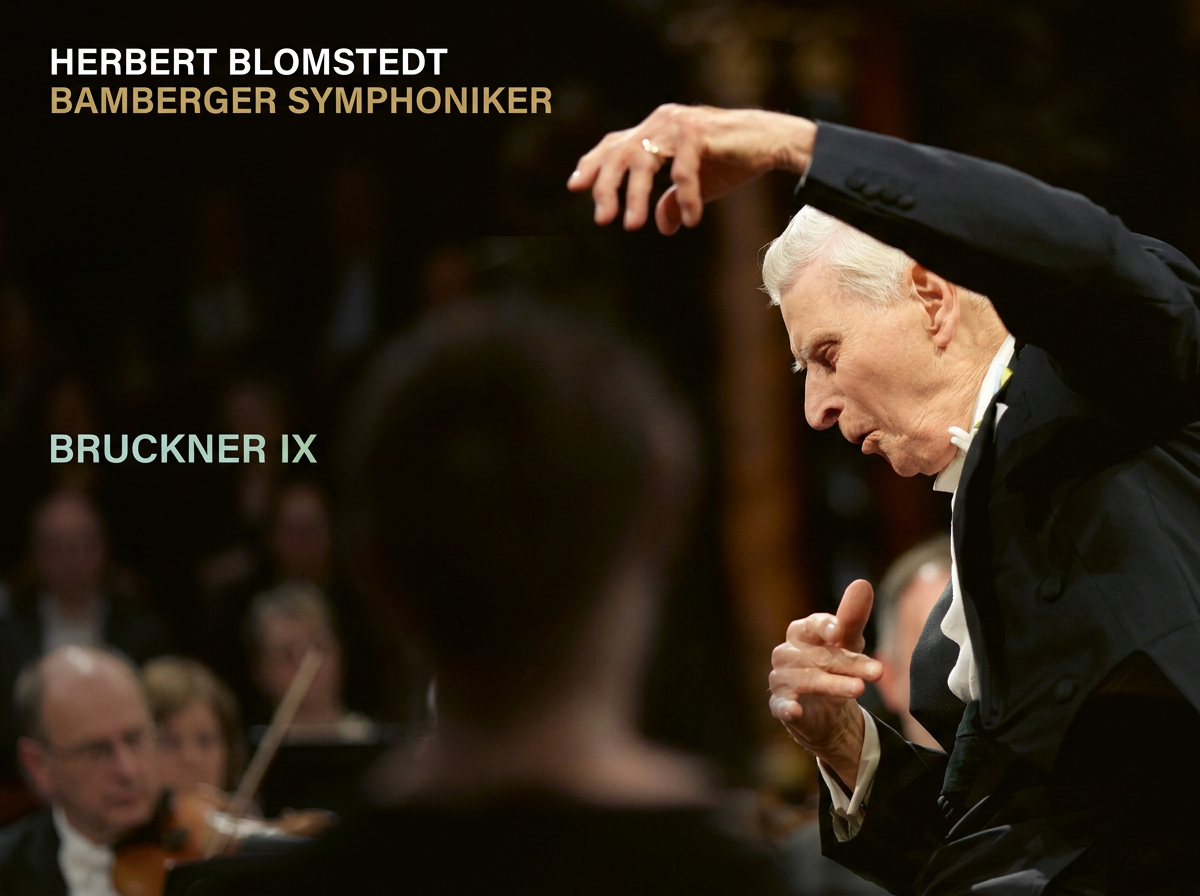
二○二四年七月十一日,布隆斯泰特在九十七歲生日當天,於布魯克納長眠的奧地利聖弗洛里安修道院(Stiftskirche St. Florian),指揮邦貝格交響樂團演出布魯克納第九號交響曲。坐在指揮席上的他,動作十分簡潔,有時甚至只用右手食指便能向樂團傳達指示。第二樂章的詼諧曲節奏強勁、重音鮮明,他沒有以大幅度的手勢強調氣勢,樂團卻能保持清晰而有力的節奏,準確掌握各聲部的變化。布隆斯泰特就是這樣,經常以極少的動作,讓聽眾感受到樂團在力度、節奏與音樂表情上的細膩變化。
On 4 November 2026, the conductor Herbert Blomstedt passed away in Gothenburg, Sweden, at the age of ninety-nine. Born in the United States to Swedish parents, the maestro enjoyed an active musical career spanning more than seven decades, during which he served as music director of the Staatskapelle Dresden, the San Francisco Symphony, and the Leipzig Gewandhaus Orchestra. That he continued to take the podium well into his nineties was owed not merely to accumulated experience, but to an undiminished sense of curiosity towards the score. Never one to rely on theatrical gestures or an authoritarian posture, Blomstedt instead employed rigorous, unadorned, and economical methods to draw from his players luminous contrapuntal lines, rhythmic equilibrium, and music animated by genuine vitality.
The Inspiration of Three Masters
In the early 1950s, while studying musicology at Uppsala University, the young Blomstedt attended a performance in Stockholm that left an indelible impression upon him. That evening, Wilhelm Furtwängler conducted the Vienna Philharmonic in a programme that began with J.S. Bach’s Third Brandenburg Concerto and proceeded directly—without an interval—into Anton Bruckner’s Eighth Symphony. Blomstedt was astonished to discover that Furtwängler deployed nearly seventy string players for Bach’s intimate chamber work, including nine double basses; yet for Bruckner’s colossal symphony, only eight double basses were used. The thick orchestral texture and sluggish tempo weighed down Bach’s music, robbing its contrapuntal dialogues and rhythmic pulse of their natural buoyancy. While deeply admiring Furtwängler’s hypnotic communicative power, the young musician could not help questioning such an interpretative approach.
Yet the Bruckner performance that followed moved him profoundly. Furtwängler and the Viennese musicians played with immense devotion, only to be met with polite, reserved applause from the Scandinavian audience. Waiting at the stage door afterwards, Blomstedt witnessed the venerable maestro emerge in a furious temper, shouting loudly: "Never again Bruckner in Stockholm, never again!" ("Nie wieder Bruckner in Stockholm, nie wieder!")
Blomstedt understood the maestro’s bitter disappointment and lamented that the Swedish public had failed to grasp the architectural majesty of Bruckner’s music. Standing in the cold, he formed a quiet resolve: one day, he would change this state of affairs. Looking back decades later, Blomstedt still recalled Furtwängler’s magnetic aura alongside his own technical doubts about such romanticised liberties. This balanced disposition—revering great predecessors without yielding to uncritical deference—became the bedrock of his artistic philosophy.
On an antique clavichord in his Gothenburg apartment, Blomstedt kept framed photographs of Wilhelm Furtwängler, Arturo Toscanini, and Bruno Walter, wryly referring to the triumvirate as his household saints (Hausheiligen). He revered Toscanini’s fierce textual fidelity and rhythmic momentum, yet rejected his tyrannical, temperamental rehearsal manner. He admired Bruno Walter’s humane courtesy towards orchestral musicians, while observing Furtwängler’s sonic alchemy with distinct reservations regarding his habit of arbitrarily halving tempos. In Franz Schubert’s Ninth Symphony ("The Great"), for instance, nineteenth-century tradition often led conductors to slow down drastically when the opening horn theme returns at the close of the first movement; yet the composer left no ritardando marking whatsoever. Blomstedt maintained that preserving the prevailing pulse allows the entire movement to cohere into a unified organic whole.
A Decade in Dresden
Blomstedt launched his professional conducting career in 1954 with the Norrköping Symphony Orchestra in Sweden, subsequently heading several major Scandinavian radio ensembles. When he first appeared as guest conductor with the Staatskapelle Dresden in 1969, he was instantly captivated by the ensemble’s distinct sonic personality. Rooted in a four-hundred-year-old opera-house tradition, the Saxon orchestra possessed warm, soft-grained strings and naturally blended winds, yielding a burnished, seamless timbre that contrasted sharply with the cooler clarity of the Nordic ensembles he knew. This sonic ideal persuaded him to accept the post of chief conductor in 1975. Over the ensuing decade, he forged an intimate rapport with the musicians, committing landmark complete cycles of the Beethoven and Schubert symphonies to disc.
By 1985, however, Blomstedt’s relationship with the East German authorities became strained. Confronted with a desperate shortage of foreign currency (Devisen), the state began dividing the Staatskapelle into smaller ensembles—string quartets and chamber groups—and sending them abroad to West Germany and Japan for lucrative engagements. These tours were arranged without consulting Blomstedt. Consequently, when the orchestra prepared for its prestigious annual concert in West Berlin, several section leaders and principal soloists were still away performing and unable to return. When Blomstedt insisted on maintaining the orchestra’s full, uncompromised roster, an official dismissed the objection, claiming that plenty of excellent musicians in East Berlin could step in as substitutes: "There are plenty of good violists here in East Berlin; you can take them." ("Es gibt hier in Ost-Berlin jede Menge gute Bratschisten, die können Sie nehmen.")
Blomstedt refused outright: "That is not the Staatskapelle! They are good musicians, very good indeed, but they do not fit into this sound." ("Das ist nicht die Staatskapelle! Das sind gute Musiker, sehr gute sogar, aber sie passen nicht in diesen Klang.")
As tensions escalated, the official issued a blunt warning: "Mr Blomstedt, we have worked together in friendship for many years. Now our friendship is at an end!" ("Herr Blomstedt, wir haben viele Jahre in Freundschaft zusammengearbeitet. Jetzt ist es mit der Freundschaft aus!")
Blomstedt recognised the ultimatum. Although their collaboration did not cease overnight, he resolved that the time had come to depart. Later that year, he concluded his ten-year tenure in Dresden and moved to the United States to take the helm of the San Francisco Symphony. Reflecting on his departure decades later, he remarked candidly: "It actually grieves me to have left the Kapelle in the lurch, but we had already worked together for ten, fifteen years, and I had to think a little about myself as well." ("Es tut mir eigentlich leid, die Kapelle da im Stich gelassen zu haben, aber zehn, fünfzehn Jahre haben wir schon zusammengearbeitet, und ich musste auch ein bisschen an mich denken.")
San Francisco and Leipzig
During his ten years in San Francisco (1985–1995), Blomstedt revitalised the orchestra’s technical standards and international profile, gaining widespread acclaim for his recorded cycles of Carl Nielsen and Jean Sibelius. In the finale of Nielsen’s Fourth Symphony (The Inextinguishable), where two sets of timpani duel across the stage, he did not merely cultivate visceral sonic power; he exposed how the cross-rhythms propelled the entire orchestral architecture. In Sibelius, he exhibited an exceptional command over terse thematic cells, charting their gradual germination into symphonic structures. These achievements established him as an authoritative champion of Scandinavian symphonism alongside the core Austro-German repertoire.
In 1998, Blomstedt was appointed music director of the Leipzig Gewandhaus Orchestra (Gewandhauskapellmeister). One of his first major initiatives was to reinstate the historical German orchestral seating plan (die deutsche Orchesteraufstellung), in which the first and second violins sit antiphonally on opposite sides of the platform. Blomstedt argued that classical and nineteenth-century symphonies relied fundamentally on the dialogic principle between the two violin sections; grouping them together on the left obscured their thematic interplay. He had contemplated this reform since his youth, but had hesitated to enforce it against players’ resistance.
Prior to taking up his Leipzig duties, he entered into protracted discussions with the ensemble. The second violins were particularly reluctant, having grown accustomed to sitting alongside the firsts where they could hear each other with ease. Relocating across the stage initially induced a feeling of acoustic isolation and insecurity. Through patient persuasion, Blomstedt won them over, training them to listen across the platform. Following his departure in 2005, the Gewandhaus Orchestra retained this seating arrangement, eventually writing it into guest conductors’ contracts as an inviolable house tradition.
Schubert Across Four Decades
A comparison between Blomstedt’s two commercial recordings of Schubert’s Ninth Symphony—with Dresden (1978–1981) and Leipzig (2021)—illustrates the evolution of his interpretative outlook over forty years. His early Dresden account opened with a measured, lyrical horn theme, characterised by velvety string phrasing and a rounded warmth typical of the Saxon opera tradition. By contrast, the 2021 Leipzig performance on Deutsche Grammophon presented crisper contrapuntal contours, throwing the spatial antiphony of the separated violin sections into sharp relief.
This stylistic shift was underpinned by scholarly developments. In Dresden, Blomstedt had conducted from Johannes Brahms’s nineteenth-century edition, which erroneously printed the first movement’s opening in common time (4/4). For the Leipzig recording, he adopted the Bärenreiter New Schubert Edition, which restores Schubert’s original alla breve (2/2) meter. This rhythmic restoration allowed the opening horn call to flow naturally at a walking pace, bridging seamlessly into the ensuing Allegro ma non troppo without the jarring gear-changes common in older interpretations. Furthermore, because Blomstedt observed every repeat in Leipzig, the overall timing expanded past sixty-one minutes; the increased length was a structural consequence of textual completeness rather than elderly inertia. Spanning four decades, these readings document how meticulous source research and practical podium experience continually refined his approach to classical form.
The Score and the Podium
Blomstedt’s fidelity to the printed page was legendary. While rehearsing Beethoven’s Third Symphony (Eroica), he questioned a prominent accent printed in the second-movement funeral march (Marcia funebre) in modern critical editions. Rehearsing with the Vienna Philharmonic, he took the opportunity to inspect Beethoven’s original orchestral parts preserved in the archive of the Gesellschaft der Musikfreunde. In one of the original parts, he found that an early player had pencilled in the Italian instruction decrescendo. A long hairpin diminuendo had simply been misread by engravers as a short dynamic accent—a minute error that completely altered the expressive arch of the phrase.
Yet loyalty to the score did not imply rigid literalism. While respecting Beethoven’s fast metronome marks, Blomstedt adjusted his tempos in practice to accommodate modern orchestral sonorities and hall acoustics, often taking tempos roughly 5 to 10 per cent slower than indicated to preserve clarity. In Bruckner’s Eighth Symphony, despite modern musicology favouring Leopold Nowak’s critical text, Blomstedt consistently adhered to Robert Haas’s edition, arguing that Haas’s restoration of cuts in the Adagio and Finale preserved the organic balance of the work. For Blomstedt, philological rigour was indispensable, but it ultimately had to serve the living musical argument in performance.
His rehearsal technique was equally distinctive. Guided by his mentor Igor Markevitch, he memorised his scores thoroughly and kept them closed on the stand, conducting in his later years entirely without a baton. Rehearsing the opening movement of Wilhelm Stenhammar’s Second Symphony with the Gothenburg Symphony Orchestra, he noticed the strings dropping dynamic volume prematurely ahead of rehearsal letter B. Halting the orchestra, he addressed them in Swedish with gentle wit: "Do not begin the diminuendo too quickly; the first half of the second bar before B must remain full fortissimo. Then you will have time to make the diminuendo in the following bar. Otherwise one ducks: ‘excuse me for existing’—which is wrong. One should play with enough sound to express: ‘be glad that you exist!’" ("Börja inte diminuendo för snabbt, utan första delen av andra takten före B är full fortissimo. Då har ni tid på er att i nästa takt göra det diminuendo. Annars duckar man: ‚ursäkta att jag finns‘—det är fel. Man ska spela med tillräckligt med klang för att uttrycka: ‚var glad att ni finns!‘")
The players laughed, and the passage returned with resonant confidence.
Blomstedt’s understated methods were not without critics. Orchestras unfamiliar with his minimal, fluid gestures occasionally struggled with entry cues; critics noted that his early Bruckner recordings sometimes faltered in pacing and transitional cohesion. His collegial, chamber-like approach demanded exceptional self-discipline and stylistic literacy from the musicians, without which his transparent textures could risk sounding unduly austere.
The Perpetual Beginner
A devout Seventh-day Adventist, Blomstedt was a lifelong vegetarian who abstained from alcohol, tobacco, and caffeine. At post-concert receptions where champagne flowed, he invariably toasted with a glass of milk, occasionally dusted with nutmeg. When asked the secret of his longevity, he would smile and point out that Winston Churchill smoked cigars, drank whisky, and lived past ninety. Blomstedt viewed long life strictly as an unearned gift of grace. In accordance with his faith, he refused to rehearse on the Sabbath (from sundown Friday to sundown Saturday), yet he willingly conducted concerts, viewing public performance as an act of ministry that conveyed solace, order, and spiritual hope.
His religious outlook subtly informed his musical sympathies. In his assessment, Gustav Mahler’s symphonies exposed raw, urban neuroses and existential dread, whereas Anton Bruckner’s vast tonal arches contemplated eternal peace. When Blomstedt recorded Mahler’s Ninth Symphony with the Bamberg Symphony in 2018 at the age of ninety-one, critics commended the crystalline counterpoint and noble restraint, though some lamented that his emotional equilibrium blunted the work’s jagged irony and tragic despair.
On 11 July 2024, on the occasion of his ninety-seventh birthday, Blomstedt conducted the Bamberg Symphony in Bruckner’s Ninth Symphony at the collegiate church of St Florian in Austria—the baroque sanctuary where the composer served as organist and beneath whose organ his remains rest. Conducting seated, Blomstedt communicated using the most economical means, at times guiding entries with no more than the index finger of his right hand. In the menacing Scherzo, he eschewed violent physical thrashing, yet drew taut, incisive accents and pristine dynamic shadings from the ensemble.
During summer vacations at his lakeside retreat in Bengtstorp, Sweden, Blomstedt could still be found engrossed in study. One summer, he picked up Sibelius’s Fifth Symphony—a work he had not conducted for a prolonged period—reading the score and humming along with the bassoon solo, still fascinated by the familiar melodies. Across more than seven decades on the rostrum, he never treated his vast experience as a finished destination. He approached the music as a perpetual beginner, convinced that in the great masterworks, there is always truth left to be discovered. (24 November, 2026)



發表留言