機會出現在杜埃尼亞斯十一歲那年,她贏得馬德里青年音樂協會(Juventudes Musicales de Madrid)獎學金,可以前往德國德勒斯登留學,於是全家從格拉納達搬到德勒斯登。面對語言隔閡與生活適應的挑戰,杜埃尼亞斯坦言那段日子彷彿一切「從負數開始」,但是全家人毫無怨言,共同努力適應環境。杜埃尼亞斯進入德勒斯登的韋伯音樂學院(Hochschule für Musik Carl Maria von Weber Dresden),師從伊格爾‧奧伊斯特拉赫(Igor Oistrakh)。兩年後,她為了投入烏克蘭裔奧地利小提琴家暨教育家庫什尼爾(Boris Kuschnir)門下,全家再次遷居至維也納。
在維也納求學期間,杜埃尼亞斯開始積極參與音樂比賽,包括在珠海莫札特國際青少年音樂周(Zhuhai International Mozart Competition for Young Musicians)小提琴B組、史畢瓦科夫國際小提琴大賽(Vladimir Spivakov International Violin Competition),以及曼紐因國際小提琴大賽青年組等比賽中奪得首獎。雖然參加史畢瓦科夫國際小提琴大賽是二○一八年,但是杜埃尼亞斯在五年前就結識史畢瓦科夫。十一歲那一年,母親把她的演奏影片寄給史畢瓦科夫,杜埃尼亞斯立刻受邀在「莫斯科迎接朋友」國際音樂節(Международный фестиваль «Москва встречает друзей»)上演出。除此之外,史畢瓦科夫還向老朋友庫什尼爾推薦杜埃尼亞斯,成為日後她轉向維也納求學的關鍵。
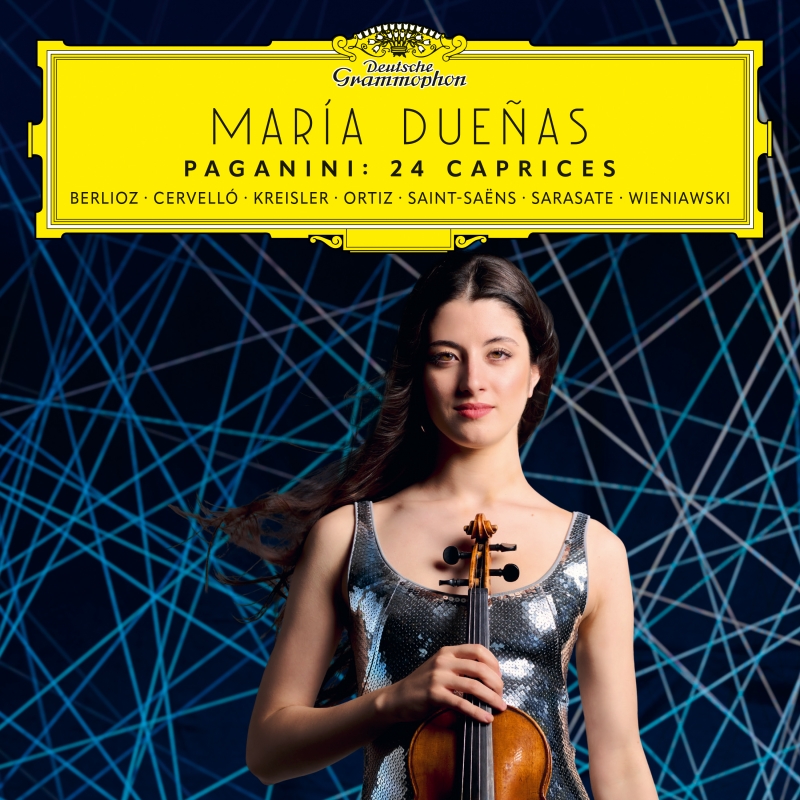
第二張專輯《隨想曲》則更進一步體現她的藝術理念。專輯雖然以帕格尼尼為小提琴而寫的二十四首隨想曲為重心,但是杜埃尼亞斯並未以此作為炫技展演,反而強調"capricho"一詞在西班牙語中所涵蓋的衝動、自由與幻想性,賦予作品更多情感層次與藝術性格的探索。所以在帕格尼尼的作品之外,她也演奏一系列受帕格尼尼影響的隨想曲作品,像是克萊斯勒《宣敘調與隨想詼諧曲》(Recitative and Scherzo Caprice)與《維也納隨想曲》(Caprice viennois)、加泰隆尼亞作曲家塞韋洛(Jordi Cervello)為杜埃尼亞斯而寫的《米爾斯坦隨想曲》(Milstein Caprice)、薩拉沙泰《巴斯克隨想曲》(Caprice Basque)、墨西哥作曲家加布里埃拉‧奧爾提斯(Gabriela Ortíz)《弦與木》(De cuerda y madera)、聖桑《安達魯西亞隨想曲》(Caprice andalou)、《序奏與輪旋隨想曲》(Introduction and Rondo capriccioso)以及白遼士《沉思與隨想》(Rêverie et caprice)。而與杜埃尼亞斯合作維尼奧夫斯基雙小提琴隨想練習曲(Études-Caprices for 2 Violins)的小提琴家,正是她在維也納的老師庫什尼爾。
二○二四年,杜埃尼亞斯參與加拿大導演博赫丹諾維奇(Sofia Bohdanowicz)所執導的電影《Measures for a Funeral》,飾演小提琴家Elisa。這部作品藉由一位音樂學者的視角,探索加拿大女小提琴家凱瑟琳·帕洛(Kathleen Parlow, 1890-1963)的生平及其對後世的影響。杜埃尼亞斯不僅擔綱演出,最後還和內澤特─塞甘(Yannick Nézet-Séguin)、蒙特利爾大都會管弦樂團(Orchestre Métropolitain de Montréal)一同演出挪威作曲家哈佛森(Johan Halvorsen)為凱瑟琳·帕洛而寫的小提琴協奏曲,成為整部電影的高潮和藝術意涵的總結。
In today's classical music world, many young violinists display stunning technique. But few achieve a deep balance between skill and emotional expression. María Dueñas, a rising star from Spain, is one of those rare artists.
Born in 2002 in Granada, Spain, María grew up in a non-musical family—her father worked in civil defense, her mother was a schoolteacher—but her mother's love for classical music deeply influenced her. María began playing the violin at a very young age, initially just to accompany her mother's lessons. However, her talent soon became clear, and her mother gave up playing to support María's musical training.
By the age of seven, María was studying at the Conservatorio Ángel Barrios in Granada. She progressed so quickly that she skipped grades and completed professional-level studies years ahead of schedule. Faced with limited options in Spain for further study and lacking the means for private tuition, her family decided to move abroad to support her education.
At age eleven, María won a scholarship from Juventudes Musicales de Madrid and moved with her family to Dresden, Germany. There she studied under Igor Oistrakh at the Hochschule für Musik Carl Maria von Weber Dresden. Two years later, she relocated again—this time to Vienna—to study with Boris Kuschnir, a respected violinist and teacher.
During her time in Vienna, María began to win several major international competitions, including in Zhuhai, Ufa, and the Menuhin Competition. One of her earliest supporters was conductor Vladimir Spivakov, who invited her to perform in Moscow and recommended her to Kuschnir. These experiences helped build her visibility and opened new doors.
In 2022, María signed with Deutsche Grammophon and released her debut album the following year. The album centers on Beethoven's Violin Concerto, featuring cadenza variations by five different composers, as well as a cadenza she wrote herself. Although she has no formal training in composition, María began composing at age 13 and uses her musical intuition to shape her artistic voice.
Her second album highlights her vision even more. While based on Paganini's 24 Caprices, María explores the Spanish meaning of "capricho"—impulse, fantasy, freedom. She includes works by composers inspired by Paganini, such as Kreisler, Saint-Saëns, and Sarasate, as well as a new piece written for her by Catalan composer Joan Valent Severo. Her teacher Kuschnir joins her in Wieniawski's piece for two violins. While Paganini's virtuosity is central, María's performance emphasizes musical depth and storytelling over mere technical showmanship.
She also expresses herself through other media. During the pandemic, she created a short film around her piano composition "Farewell", reflecting on her family's emotional move from Spain to Germany. In 2024, she acted in the film "Measures for a Funeral" by Canadian director Sofia Bohdanowicz, portraying violinist Elisa. The film explores the life and legacy of Canadian violinist Kathleen Parlow, and María performs in the film's climactic concert scene.
From a young girl in Granada to a global stage, María Dueñas has shown not only great talent, but a deep commitment to emotional honesty, artistic exploration, and cross-disciplinary expression. Her work points to a future rich with promise—for her, and for the art of music itself.
*This English version is a concise summary of the original Chinese article.*
PAGANINI 24 Caprices for Violin Solo op. 1 María Dueñas (violin) Pfaffendorf, Austria, 9 & 12/2023, 1–6 & 8–9/2024
DE SARASATE Caprice basque op. 24 (for violin and piano) María Dueñas (violin), Itamar Golan (piano) Pfaffendorf, Austria, 9/2023
KREISLER Recitativo & Scherzo-Caprice op. 6 (for violin solo) KREISLER Caprice viennois op. 2 (arr. for violin and guitar by Antoine Fougeray) María Dueñas (violin), Raphaël Feuillâtre (guitar, for Caprice viennois) Pfaffendorf, Austria, 12/2023 & 5/2024
WIENIAWSKI Étude-Caprice in E flat major op. 18/2 (for 2 violins) María Dueñas (violin), Boris Kuschnir (violin) Pfaffendorf, Austria, 12/2023
ORTIZ De cuerda y madera (Capriccio for violin and piano, World premiere recording) María Dueñas (violin), Alexander Malofeev (piano) Pfaffendorf, Austria, 9/2024
SAINT-SAËNS Caprice andalous op. 122 (for violin and orchestra) María Dueñas (violin), Deutsches Symphonie-Orchester Berlin, Mihhail Gerts (conductor) Berlin, Teldex Studio, 6/2024
BERLIOZ Rêverie & Caprice op. 8 (for violin and orchestra) María Dueñas (violin), Deutsches Symphonie-Orchester Berlin, Mihhail Gerts (conductor) Berlin, Teldex Studio, 6/2024
SAINT-SAËNS Introduction & Rondo capriccioso op. 28 (for violin and orchestra) María Dueñas (violin), Deutsches Symphonie-Orchester Berlin, Mihhail Gerts (conductor) Berlin, Teldex Studio, 6/2024



發表留言