
大都會的豪賭與北歐新天后:麗絲‧大衛德森的聲音革命
  紐約大都會歌劇院近年的財務狀況相當嚴峻。為了填補長期入不敷出的財務缺口,劇院不得不動用超過一點二億美元的捐贈基金本金,等於開始消耗原本用來救急的老本;同時,其信用評等也被信用評級機構穆迪(Moody's)降到俗稱「垃圾級」的Caa1,代表外界認為它未來週轉資金會更困難,甚至存在無法償還債務的風險。即使財務狀況如此吃緊,大都會歌劇院仍然決定投入將近四百萬美元,推出華格納《崔斯坦與伊索德》全新製作。這幾乎像是一場不得不投注的豪賭,因為劇院急需一部能吸引觀眾、創造話題與票房的作品。結果,這場賭局贏了,演出幾乎場場完售,甚至還罕見加演。票房成功有一部分要歸功於導演尤瓦爾‧雪倫(Yuval Sharon)和舞台設計師艾絲‧戴夫林(Es Devlin)帶來的話題。不過,更重要的還是主角歌手本身。這部作品對主演者的技巧要求極高,在大都會原本就難得上演,因此吸引觀眾進場的關鍵,仍是飾演伊索德的挪威女高音麗絲‧大衛德森(Lise Davidsen)。

  大都會對大衛德森的器重不是從《崔斯坦與伊索德》才開始。早在二〇二三年九月,劇院就把三千七百八十六個座位的主舞台交給當時三十六歲的大衛德森開個人獨唱會。這在近代非常罕見,因為主舞台的空間是為歌劇設計,極少有歌手敢一個人撐起整個舞台。大衛德森不但做到,而且獨唱會全場滿座。笛卡唱片隨後把當晚的精華錄音發行為《大都會歌劇院現場》(Live at the Met),鋼琴伴奏是貝里尤(James Baillieu)。事後看來,《崔斯坦與伊索德》的票房,不過是再次印證了劇院兩年前的判斷:至少在大都會,大衛德森已經是少數真正能把票賣掉的名字之一。

天賦異稟:從「大型機器」到華格納女高音

  大衛德森不是出身音樂世家,她在挪威南部的鄉間小鎮長大。因為喜歡唱歌,她進入葛利格音樂學院(Grieg Academy of Music)就讀,而且一直被當成次女高音,唱了四年巴洛克曲目與合唱團的女低音聲部。直到二〇一〇年進入哥本哈根丹麥皇家音樂學院(Royal Danish Academy of Music)向聲樂名師埃肯(Susanna Eken)求教後,埃肯直接告訴她:妳是女高音,別再唱巴洛克了,去唱十九世紀的歌劇!

  埃肯形容大衛德森的體格與嗓音潛力是一部「大型機器」,要她學會用整個身體來唱歌。這個比喻其實十分貼切。大衛德森身高一百八十八公分,高大的骨架和寬闊的胸腔提供天生的大型共鳴腔和充沛的肺活量。一旦這部機器被正確啟動,她可以發出帶有金屬光澤的高音,即使面對華格納動輒上百人的管弦樂團,聲音仍然能輕鬆穿透而不緊繃。那四年聲部錯誤的經歷也沒有浪費,而是替大衛德森打下厚實的中低音域底子。高音能穿透、中低音又飽滿,這種組合讓歐洲評論界把她看成弗拉絲塔德(Kirsten Flagstad)和尼爾森(Birgit Nilsson)之後最重要的北歐戲劇女高音。一百八十八公分的身高在舞台上也是天然的優勢。華格納歌劇裡的女主角,往往不是女神就是女武神,但是大衛德森從來不需要借助誇張的肢體動作或華麗服裝來放大存在感,因為她只要站上舞台,就會自然散發出莊嚴的氣場,與華格納音樂中深沉、緩慢流動的力量完美契合,輕易撐起那些宏大且沉重的角色。

一體兩面:嚴謹藝術與親民綜藝的交織

  這張專輯最有趣的地方,是它同時呈現出兩個截然不同的大衛德森。前半部是嚴肅的戲劇女高音。普契尼《托斯卡》的〈為了藝術,為了愛〉(Vissi d'arte)其實是當晚的安可曲,唱片公司發行時把它搬到第一軌當開場,從澎湃的高音一路收到極弱音的那段控制力確實驚人。威爾第《假面舞會》〈我就要死去,但是最後一個願望〉(Morrò, ma prima in grazia)則讓人聽到她招牌的厚實中低音域。德語藝術歌曲則證明,這部大型機器並不只有『大聲』一種模式。理查‧史特勞斯的〈明天!〉(Morgen!)裡,她把聲音收得非常細,和鋼琴的聲線幾乎融在一起;到了舒伯特的〈紡車旁的葛蕾卿〉(Gretchen am Spinnrade),又能立刻轉為充滿壓抑感的內在張力。華格納《唐懷瑟》〈在這神聖的殿堂〉(Dich, teure Halle)自然是機器馬力全開的時刻。北歐曲目是她最沒有距離感的領域,以母語或是接近母語的瑞典語演唱四首西貝流士的藝術歌曲,以及葛利格的〈春〉(Våren)。〈春〉放在專輯最後一首,大衛德森褪去了所有架勢,以像和一屋子朋友說話的輕柔聲音演唱。

  另一個嫵媚可親的大衛德森在後半部出來了。她唱起卡爾曼(Emmerich Kálmán)輕歌劇《吉普賽公主》的詠嘆調〈我的家在山上〉(Heia, in den Bergen),還帶著觀眾跟節奏拍手。接著是百老匯音樂劇《窈窕淑女》的〈我可以徹夜跳舞〉(I Could Have Danced All Night),到了曲末輕輕鬆鬆飆上一個漂亮的高音,全場觀眾氣氛為之沸騰。

兩岸論爭:商業消耗與藝術傳承的拉鋸

  但真正讓保守派坐不住的,不是她唱了什麼,而是她在演出當中竟拿起麥克風,像主持人一樣跟觀眾聊天。在歐洲傳統的獨唱會文化裡,歌手在台上拿起麥克風與觀眾聊天,幾乎是難以想像的事。堅守歐洲嚴肅傳統的保守派樂評人,如美國的諾德林格(Jay Nordlinger)嚴厲批評這是一種「美國病」,覺得它破壞了藝術歌曲那種需要全神貫注的氣氛。不過,在唱片正式發行時,這些談話與互動的片段並未被收錄,留下來的僅是純粹的演唱內容。換句話說,聽眾如果只透過這張專輯認識大衛德森,未必會意識到現場演出其實帶有相當強烈的綜藝感與親近感。

  但是反差也正在這裡。就算是批評最狠的人,也對她的演唱本身挑不出毛病。沒有人否認那個高音C的品質,也沒有人說理查‧史特勞斯和舒伯特唱得不夠細膩。這張專輯因此很精準地反映了大衛德森目前的處境:她的實力沒有爭議,有爭議的是她選擇用什麼方式,把這個實力送到觀眾面前。對此,大西洋兩岸態度其實存在明顯差異。美國市場喜歡她打破框架的親和力,覺得她是古典樂拉攏新觀眾的解方,歐洲評論界則更在意聲樂實質內涵與傳統的延續。

  伴隨大衛德森演唱事業成功的最大隱憂是商業消耗。現在的歌劇界非常缺能唱華格納的戲劇女高音,大衛德森因此承受著提早接演重型角色的壓力。埃肯就公開說過,大衛德森這副嗓子條件好到可以唱到六十歲,所以一定要晚一點再碰布倫希爾德(Brünnhilde)這類最吃力的角色。何況現在的歌劇生態比弗拉絲塔德或尼爾森的年代更消耗體力,製作更繁重,巡演更密集,過勞的風險高了許多。

聲音實驗:古典音樂與當代觀眾的對話

  從這個角度審視這張專輯的曲目,會有不一樣的觀察點。曲目跨度非常大:華格納和威爾第代表重型火力,藝術歌曲要求的是收放自如的細膩度,輕歌劇和音樂劇則讓嗓子在完全不同的張力之間切換。我不確定這是不是有意識的保護策略,但對一個隨時可能被推向「只唱華格納」的歌手來說,這樣的曲目安排至少讓聽眾看到她不只一種的面相。

  在大都會歌劇院最艱難的時候,大衛德森以頂尖的嗓音搭配不按牌理出牌的展演方式,成功把觀眾拉進劇院。這張專輯記錄的不僅是當代最出色的戲劇女高音聲音之一,也是今日古典音樂表演製作人,如何面對觀眾並開拓市場的實測過程。(2026年7年21日)
The financial situation of the New York Metropolitan Opera (The Met) has been exceedingly precarious in recent years. To plug a chronic structural deficit, the house has been forced to draw over $120 million from its endowment principal, effectively depleting the reserves originally intended for emergencies. Concurrently, its credit rating was downgraded by the agency Moody’s to Caa1, commonly known as ‘junk’ status, signalling to the wider world that the institution will face greater difficulties in securing future liquidity and even runs the risk of defaulting. Despite these severe financial constraints, the Met proceeded to invest nearly $4 million in a new production of Richard Wagner’s “Tristan und Isolde". This felt almost like a desperate gamble, as the house urgently needed a production capable of drawing audiences, generating buzz, and boosting box-office revenues. Ultimately, the gamble paid off: the run was virtually sold out, prompting a rare additional performance. While this box-office triumph is partly attributable to the talking points generated by director Yuval Sharon and stage designer Es Devlin, the more crucial factor was the lead singer. The work demands exceptional vocal technique from its leads and is rarely staged at the Met; thus, the key to attracting audiences lay firmly with the Norwegian soprano singing Isolde, Lise Davidsen.
The Met’s high regard for Davidsen did not begin with “Tristan und Isolde". As early as September 2023, the house handed its 3,786-seat main stage over to the then 36-year-old Davidsen for a solo recital. This is an exceptionally rare occurrence in modern times, as the main stage’s vast space is designed for grand opera, and very few singers would dare to command it alone. Davidsen not only achieved this, but performed to a “packed house". Decca Classics subsequently released the highlights of that evening’s recording as the album “Live at the Met", accompanied by pianist James Baillieu. In retrospect, the box-office success of “Tristan und Isolde" merely validated the house’s judgement from two years prior: at least at the Met, Davidsen is one of the few names that can genuinely sell tickets.
Extraordinary Talent: From a “Big Machine" to a Wagnerian Soprano
Davidsen does not hail from a musical dynasty; she grew up in a rural town in southern Norway. Driven by a love for singing, she enrolled at the Grieg Academy of Music, where she was classified as a mezzo-soprano, spending four years singing Baroque repertoire and the alto parts in choral ensembles. It was not until 2010, when she entered the Royal Danish Academy of Music in Copenhagen to study with the renowned vocal teacher Susanna Eken, that her path changed. Eken told Davidsen directly “that she wasn’t a mezzo, but a soprano, and that she should not sing Baroque oratorios, but 19th-century opera".
Eken described Davidsen’s physique and vocal potential as “a big machine", instructing her that “she had to work with her body" to sing. This metaphor is highly apt. Standing at 188 centimetres (6 ft 2 in), Davidsen’s tall frame and broad chest provide her with a naturally massive resonating chamber and abundant lung capacity. Once this machine is properly engaged, she can produce high notes with a metallic sheen, penetrating effortlessly and without strain through Wagner’s orchestras, which frequently exceed a hundred musicians. Those four years of singing in the ‘wrong’ vocal range were not wasted; rather, they provided Davidsen with a robust and rich lower-middle register. This combination of piercing highs and full-bodied lows has led European critics to regard her as the most significant Nordic dramatic soprano since Kirsten Flagstad and Birgit Nilsson. Her 188-centimetre stature is also a natural advantage on stage. The heroines in Wagner’s operas are often either goddesses or Valkyries; however, Davidsen never needs to rely on exaggerated physical gestures or elaborate costumes to amplify her presence. Simply by standing on stage, she naturally exudes a majestic aura that perfectly aligns with the profound, slow-moving power of Wagner’s music, effortlessly carrying these grandiose and weighty roles.
Two Sides of a Coin: The Interweaving of Rigorous Art and Approachable Entertainment
The most fascinating aspect of this album is that it simultaneously presents two distinctly different sides of Davidsen. The first half features the serious dramatic soprano. Giacomo Puccini’s ‘Vissi d’arte’ from “Tosca" was actually the evening’s encore, but the record label moved it to the very first track to serve as the opener; her control as she descends from a soaring high note down to a “pianissimo" is truly astonishing. Giuseppe Verdi’s ‘Morrò, ma prima in grazia’ from “Un ballo in maschera" allows listeners to hear her signature rich lower-middle range. The German “Lieder" demonstrate that this large machine has more than just a ‘loud’ setting. In Richard Strauss’s ‘Morgen!’, she scales her voice back exquisitely, her vocal line almost blending with the piano; yet in Franz Schubert’s ‘Gretchen am Spinnrade’, she can instantly pivot to an internal tension brimming with suppression. Wagner’s ‘Dich, teure Halle’ from “Tannhäuser" is, naturally, the moment the machine operates at full throttle. The Nordic repertoire is the domain where she feels least distant; she performs four art songs by Jean Sibelius in Swedish (a language close to her mother tongue), alongside Edvard Grieg’s ‘Våren’. Placed as the final track on the album, ‘Våren’ sees Davidsen strip away all grandiosity, “sounding as if Davidsen were singing to a roomful of friends" with a gentle voice.
Then, in the second half, another charming and approachable Davidsen emerges. She sings the aria ‘Heia, heia, in den Bergen ist mein Heimatland’ from Emmerich Kálmán’s operetta “Die Csárdásfürstin", even encouraging the audience to clap along to the rhythm. This is followed by ‘I Could Have Danced All Night’ from the Broadway musical “My Fair Lady"; towards the end of the song, she effortlessly hits a beautiful high C, sending the audience into a frenzy of excitement.
A Transatlantic Debate: The Tug-of-War Between Commercial Consumption and Artistic Heritage
However, what truly unsettled conservatives was not what she sang, but the fact that she picked up a microphone during the performance to chat with the audience like an emcee. In the traditional European recital culture, a singer holding a microphone to converse with the audience on stage is almost unimaginable. Conservative critics defending the serious European tradition, such as the American critic Jay Nordlinger, harshly criticised this, stating “she seems to have caught the American disease: talking throughout a recital," feeling that it shattered the atmosphere of complete absorption required for art songs. Nevertheless, when the record was officially released, these spoken segments and interactions were not included; what remains is purely the vocal performance. In other words, listeners introduced to Davidsen solely through this album might not realise that the live performance actually possessed a remarkably strong sense of variety-show entertainment and intimacy.
Yet, this is precisely where the contrast lies. Even her harshest critics can find no fault with her singing itself. Nobody denies the quality of that high C, nor does anyone claim her Strauss and Schubert lack refinement. This album thus accurately reflects Davidsen’s current predicament: her vocal prowess is undisputed; what is debated is the manner she chooses to deliver this talent to the audience. On this issue, there is a clear divergence of attitudes across the Atlantic. The American market appreciates her boundary-breaking approachability, viewing her as classical music’s solution to attracting new audiences; the European critical establishment, conversely, is far more concerned with the substantive depth of vocal art and the continuation of tradition.
The greatest hidden concern accompanying Davidsen’s vocal success is commercial burnout. Today’s operatic world is severely lacking in dramatic sopranos capable of singing Wagner, subjecting Davidsen to immense pressure to take on heavy roles prematurely. Eken has stated publicly that “she can sing Brünnhilde until she is 60, so wait with it" and avoid the most taxing roles for now. Furthermore, the contemporary operatic ecosystem is physically more draining than in the eras of Flagstad or Nilsson, with more demanding productions and denser touring schedules, significantly increasing the risk of burnout.
Vocal Experimentation: A Dialogue Between Classical Music and Contemporary Audiences
Viewing the album’s tracklist from this perspective offers a different angle of observation. The repertoire spans a vast range: Wagner and Verdi represent heavy firepower; the art songs demand finely controlled subtlety; whilst the operetta and musical theatre pieces force the voice to switch between entirely different tensions. It is uncertain whether this is a conscious protective strategy, but for a singer who could at any moment be pigeonholed into singing ‘only Wagner’, such a programme at least shows the audience that she possesses more than just one facet.
During the Metropolitan Opera’s most difficult times, Davidsen has successfully drawn audiences back into the theatre with her world-class voice, paired with an unconventional performance style. This album documents not only one of the finest dramatic soprano voices of our time, but also a real-world test by today’s classical music producers on how to face audiences and pioneer new markets. (21 July, 2026)
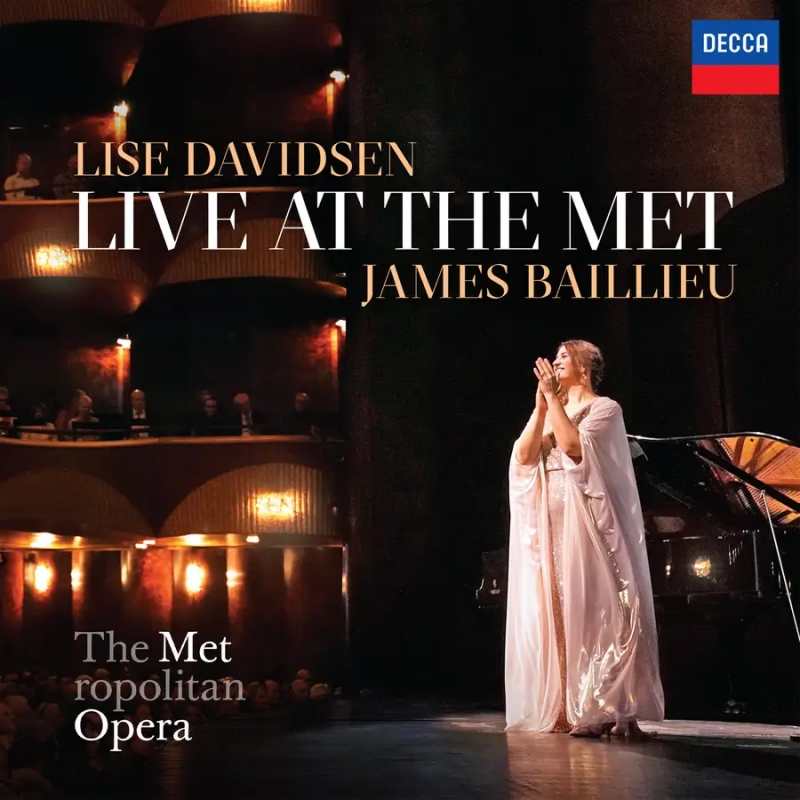
Lise Davidsen: Live at the Met
Lise Davidsen (soprano), James Baillieu (piano)
September, 2023, Metropolitan Opera House, New York


發表留言