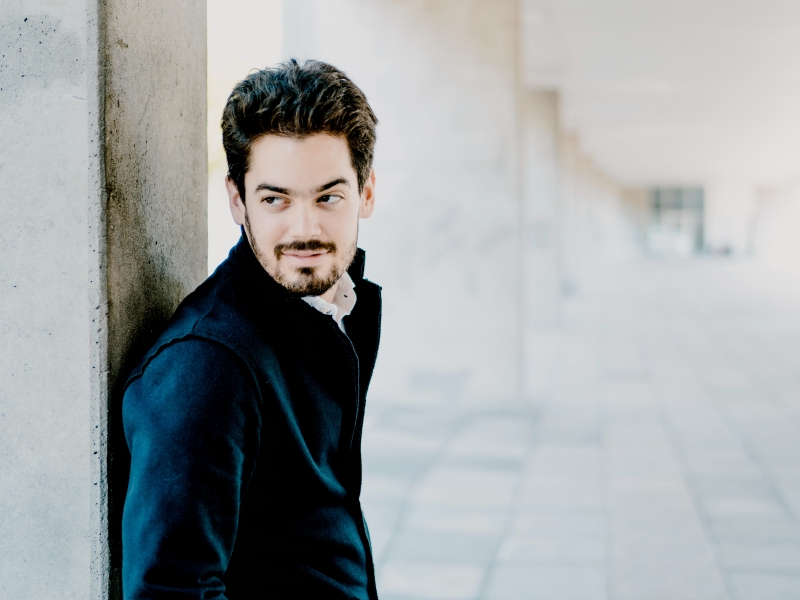
In late spring 2026, an intriguing coincidence appears in the itinerary of conductor Lahav Shani. Between late April and early May, he will first lead the Munich Philharmonic for three performances in Taipei and Kaohsiung; six weeks later, in mid-June, he will return to the National Kaohsiung Center for the Arts (Weiwuying), this time with the Rotterdam Philharmonic Orchestra. One conductor, one concert hall, and two world-class orchestras—looking at Shani’s global tour schedule this year, Kaohsiung is the only city to witness this specific combination.
This is not merely a scheduling coincidence. In September 2026, Shani will officially take up the baton as Chief Conductor of the Munich Philharmonic; in the summer of the same year, his eight-year tenure as Chief Conductor of the Rotterdam Philharmonic will come to an end. In other words, his May appearances with the Munich Philharmonic serve as a prelude to his new post, while the June performances with the Rotterdam Philharmonic mark a farewell to his long-standing colleagues. The convergence of new beginnings and old partnerships happens to unfold on stage in Taiwan.
A Century-Old Institution Under a Political Cloud: Shani's Succession Challenge
The circumstances under which Shani takes over the Munich Philharmonic are highly complex. His predecessor, Valery Gergiev, was abruptly dismissed shortly after the outbreak of the war in Ukraine for refusing to publicly condemn Vladimir Putin’s regime within a given deadline. Consequently, Shani is stepping into a century-old institution that has just weathered a political earthquake; the orchestra needs not just a musical successor, but someone who can redirect the focus from political controversy back to the music itself.
However, the anticipated 'return to music' did not truly materialise, as Shani himself was soon enveloped by political clouds. As an Israeli and the Music Director of the Israel Philharmonic Orchestra, Shani became a focal point of protests in Europe amidst the war in Gaza. In September 2025, the Flanders Festival Ghent in Belgium unilaterally cancelled the Munich Philharmonic's performance, citing that they were "unable to provide sufficient clarity about his attitude to the genocidal regime in Tel Aviv". With two consecutive conductors facing boycotts for failing to sever ties with their respective national leaders, the same orchestra has been pushed from one end of the political spectrum to the other in just a few years, making the simple act of attending a concert increasingly fraught in contemporary Europe.
A Transparent Sonic Revolution: The Suspense of Deconstructing Mahler's Titan
Historically, under the long-term stewardship of maestros such as Sergiu Celibidache and Christian Thielemann, the Munich Philharmonic was renowned for a heavy, slow, and ritualistic sound. This reflects a deeply traditional German aesthetic—one imbued with solemnity but also a certain sense of distance. Upon taking over, Shani did not perpetuate this musical vocabulary; instead, he steered towards a different direction: more transparent structures, more agile dynamics, and section dialogues that more closely resemble chamber music.
This new route is not without its controversies. The German newspaper *Süddeutsche Zeitung" once described Shani with the term "Klangvollender" ("completer of sound"). Yet, in the context of German music criticism, this term carries a subtle reservation. It implies that while he excels at crafting a gorgeous, complete, and superficially flawless sound, the internal tension and the spiritual weight—the kind that builds from the profound depths to the ultimate climax in large-scale Austro-German works—can sometimes be diluted by this overly beautiful sonority.
Listening to Shani conduct the Munich Philharmonic in Mahler’s Symphony No. 1, "Titan", at Weiwuying in early May provides an excellent opportunity to examine this critique. Audiences might focus their attention on two particular moments: First, the introductory movement awakening from silence, where the cuckoo motif gradually builds until the first bright, explosive arc—is there a genuine driving force, or does it merely linger on a beautiful sound surface? Second, the long-line accumulation in the finale, transitioning from the storm of hell to the song of triumphant victory—is it a natural progression, or an artificially and meticulously engineered effect? These two segments are the easiest ways to test whether Shani genuinely suffers from the issue of "beauty masking structural depth," making them the most compelling moments to listen out for that evening.
The West-Eastern Divan Cultivation: Empathy from the Pit to the Podium
The June performances with the Rotterdam Philharmonic tell an entirely different story. Shani’s relationship with this Dutch orchestra began with a guest appearance in 2016. At the age of 27, just two months after this debut, he was unanimously voted in by the musicians as their Chief Conductor. This is exceptionally rare in the classical music world. For a young, foreign conductor to be collectively embraced by a venerable orchestra after just one collaboration relies not on seniority, but on the genuine chemistry generated when working together on stage.
To understand why Shani could achieve this, one must look back at his earlier experiences. In 2010, having recently arrived in Berlin to study, he accompanied a friend to an audition for the West-Eastern Divan Orchestra, an ensemble comprising Israeli and Arab musicians. Playing as an accompanist, he unexpectedly caught the attention of Daniel Barenboim. In the following years, Shani joined the orchestra as a double bass player, observing from within how Barenboim worked. Later, their roles reversed: Shani took up the baton, while Barenboim returned to the piano as a soloist. Around 2015, during an encore at a West-Eastern Divan Orchestra concert, Barenboim handed his baton directly to Shani, introducing this young successor to the entire audience.
A Rotterdam-style Farewell: A Declaration of Rapport through Play-Conducting
These experiences profoundly shaped Shani’s conducting philosophy. Having been an orchestral player, he knows the physical limits of the string sections and understands the feeling of being cornered by a dictatorial conductor. Therefore, he insists that a conductor should be a part of the orchestra, not an outsider issuing orders. In Rotterdam, he pushed this concept to its limits: rehearsals resemble open chamber music discussions, where musicians are treated as co-decision-makers rather than mere executors. The Rotterdam Philharmonic responded with an orchestra culture willing to take risks and unafraid of failure. As Shani himself described the musicians, "they are completely fearless, they take risks and they don’t mind taking risks and falling off the cliff".
This mutual trust has been cultivated over eight years. For the June 13th concert in Kaohsiung, the programme specifically features Shostakovich’s Piano Concerto No. 2, directed by Shani from the keyboard. This piece is lightly orchestrated, structurally clear, and leans towards a neoclassical style. By including it in his farewell concert, Shani is not so much making a philosophical manifesto as he is channelling eight years of cultivated listening rapport into a piece that requires no forceful conducting authority—only musicians attentively listening to one another. This is a very Rotterdam-style way to say goodbye.
The Munich Philharmonic represents a century-old ensemble burdened by its own heavy historical baggage, just emerging from a political storm. Shani is about to redefine its musical vocabulary with his transparent sonic aesthetics, and this period of adjustment is only just beginning. Conversely, the Rotterdam Philharmonic represents a partnership that has reached its finish line—mature, deeply acquainted, and mutually reassuring; the June concerts will serve as its full stop. To be able to hear Shani navigate these two vastly different orchestral relationships within six weeks, in the exact same concert hall and under identical acoustic conditions, is truly an exceptionally rare and precious opportunity. Though the focal points for listening differ between the two sets of concerts, both promise to deliver highly inspiring observational experiences, making them well worth the anticipation of any music lover. (28 April, 2026)



發表留言