
《東西交會》詮釋當代:慕特出道五十週年的「前瞻」宣言
  一九七六年八月二十三日,十三歲的慕特(Anne-Sophie Mutter)與年長近兩歲的哥哥在琉森音樂節舉行生平第一場正式獨奏會,也為她的音樂事業推開大門。到了二〇二六年,她的國際演奏生涯屆滿五十週年。遇到這種整數週年,多數音樂家往往會選擇重錄招牌曲目或推出精選輯,慕特卻走了另一條路:她決定整理自己數十年來委託創作、首演的當代作品。於是,她和廠牌 Alpha Classics 合作推出《ASM Forte Forward》系列,以四張專輯回顧這段歷程。第一張就是今年三月發行的《東西交會》(East Meets West)。慕特的理由很簡單:如果沒有錄音留傳下來,對後來的學生與聽眾來說,這部作品就等於不存在。慕特過去雖然錄過魯托斯拉夫斯基(Witold Lutosławski)、杜提耶(Henri Dutilleux)、潘德列茨基(Krzysztof Penderecki)、古拜杜林娜(Sofia Gubaidulina)⋯⋯等人的作品,但是還有許多為她量身譜寫的新曲沒有錄下來。這張專輯要補的,就是這塊歷史的缺口。

從傳統框架跳進當代冰水

  慕特早年的曲目集中在莫札特、貝多芬、布拉姆斯這些古典與浪漫派重心。她承認一直到一九八〇年代中期為止,自己對當代音樂沒什麼熱情。真正把她推進當代音樂世界的,是長年支持新作委託的瑞士指揮家沙卻(Paul Sacher)。一九八六年,沙卻委託波蘭作曲家魯托斯拉夫斯基創作《鏈之二》(Chain 2),並指定由慕特擔任獨奏。慕特形容那一次的感受像是「跳進冰水裡」,一度手足無措。但是這次經驗讓她對首演當代作品上了癮,而且意識到:如果每個時代的演奏家都只重複上個世代的曲目,那麼當下這個時代,將不會在音樂史上留下自己的聲音。此後四十年,委託與首演新作逐漸成為慕特演奏生涯的重要部分,而《東西交會》正是這條路徑的階段性總結之一。

  四首作品的編制安排,也呈現出一種由小到大的層次:從無伴奏獨奏開始,接著是雙小提琴、弦樂四重奏,最後進入協奏曲。四名作曲家則分別來自伊朗、韓國、德國與英國,呼應專輯「東西交會」的主題。

文化交織下的技術極限

  為了呼應巴赫的無伴奏系列作品傳統,伊朗裔荷蘭作曲家達爾維希(Aftab Darvishi)《離歌》(Likoo)選擇寫成無伴奏小提琴曲,並且採用一些巴赫式的音型與和聲。但是,作品本身真正的根源並不在西方,而是來自伊朗東南部俾路支省的一種內容圍繞著失去家園、孩子與自由的傳統悲歌。慕特在慕尼黑錄製《離歌》的時間是二〇二五年六月中旬,也是以色列對伊朗展開為期十二天軍事行動的時候。達爾維希人在海外,家鄉卻被轟炸。她在錄音現場對慕特說:「我現在聽自己的音樂有了不同的感受。它所表達的哀傷,已經有全新的意義。」一首曲子原本寫的是抽象的失去,錄音那天變成正在發生的事實。

挑戰技術極緻的《大裝飾奏》

  在傳統協奏曲裡,「裝飾奏」(Cadenza)通常是獨奏家展現技巧的段落。韓國作曲家陳銀淑的雙小提琴曲《大裝飾奏》(Gran Cadenza),卻把這個概念拆成兩把小提琴之間的對峙。動態從極弱(triple piano)到近乎暴烈的極強(triple fortissimo),兩人時而對話,時而像在決鬥。初讀樂譜時,慕特曾私下向陳銀淑質疑某些輕盈的泛音段落「更適合長笛」。但是陳銀淑不僅在首演排練時親自坐在第一排盯場,更曾直白地回應她:「妳沒意識到自己有多優秀。」意謂對慕特演奏技術毫不保留的信任,這也果然促使慕特在小提琴上發展出模擬長笛音色的方法:因為她的手小,在極高音域、高把位指板的狹窄空間裡反而更容易活動,連最難運用的小指都能靈活伸展,輕輕觸弦,就能拉出輕盈、透明、像空氣一樣飄浮,聽起來真的很像長笛的聲音。為了在極複雜的節奏裡與搭檔維持毫無偏差的同步,慕特也透露了一個錄音中聽不到的秘密:她必須在長裙底下偷偷用腳打拍子,才能確保兩把小提琴絕對同步。首演之後,慕特帶著這首曲子進行世界巡迴,期間共與多位不同的小提琴家合作過。最終收錄在專輯中的版本,是二〇二三年二月與小提琴家周穎在紐約卡內基廳的現場錄音。

透過《探究貝多芬》世代傳承

  耶爾格‧韋德曼(Jörg Widmann)第六號弦樂四重奏《探究貝多芬》(Studie über Beethoven)於二〇二〇年二月在東京三得利廳首演,當時正逢貝多芬誕辰二五〇週年紀念年。這首曲子也讓耶爾格‧韋德曼繼續寫出四首以「貝多芬探究」為共同標題的弦樂四重奏。

  《第六號弦樂四重奏》大膽挑戰了貝多芬晚期降B大調第十三號弦樂四重奏。耶爾格‧韋德曼把其中著名的「德意志舞曲風格」(Alla danza tedesca)樂章予以拆解,嵌進自己的音樂語言裡。全曲切成十一個短段落,速度與情緒急促轉換,不僅用刺耳的酸澀和聲與急促的變速來顛覆經典,整體更維持著一種光與暗彼此拉扯的張力。慕特形容,這首曲子的結尾並沒有明確走向光明,而是留下一個問號。參與錄音的幾位年輕音樂家,包括小提琴家崔藝恩、大提琴家費蘭德斯(Pablo Ferrández)、中提琴家拉札維(Muriel Razavi),都是慕特基金會(Anne-Sophie Mutter Stiftung)贊助的青年音樂家。對慕特而言,培育這些年輕音樂家不能僅停留在資金贊助的層次,她更將「同台演出」與「共同錄音」視為最核心的世代傳承方式。

  阿德斯(Thomas Adès)的協奏曲《Air,獻給西貝流士》(Air – Homage to Sibelius)寫於疫情期間。作品源自一個耐人尋味的矛盾:音樂必須透過空氣傳播,但在疫情期間,空氣卻成為人們最警惕的傳染媒介,音樂家甚至一度被視為「超級傳播者」。因此,《Air》不僅是一個簡潔的標題,更像是一種提醒:音樂之所以存在,正是因為空氣的流動與振動;這個看似平常的事實,在疫情年代反而顯得格外深刻。

  為了展現空氣的飄浮感,阿德斯把獨奏旋律寫在小提琴的極高音域,從頭到尾幾乎都在指板最末端盤旋,聽起來輕盈、懸浮。但是製造這種漂浮感的代價,是演奏者的左手必須倚賴小指不斷往更高的位置攀爬。聽覺上越像無重力,演奏起來其實身體是越費力。

把作品置於自我之前

  這張專輯的四首作品全部由慕特首演,現在又由她首錄。一般慣例,一部作品的首演者與首錄者,往往也等於未來數十年最具權威性的詮釋標準。但是慕特認為自己的詮釋沒有絕對約束力,而是希望其他演奏家能找出自己的詮釋路徑。五十年前,卡拉揚教慕特讀貝多芬小提琴協奏曲樂譜的時候,她提出某些指法在小提琴上不容易做到,卡拉揚直接回答:「我不在乎這在小提琴上是否可能;但是在音樂上必須是可能。」當年卡拉揚教會她「把音樂的重要性置於樂器之前」;半個世紀後的今天,面對當代音樂,慕特更進一步展現「把作品的生命力置於自我權威之前」的豁達。專輯解說冊有句結語是:「這是一個起點,不是終點」(This project is intended to be a beginning, not an end.)。這正好說明專輯問世之時,才是一切詮釋可能之始。(2026年8月11日)
On 23 August 1976, thirteen-year-old Anne-Sophie Mutter, alongside her elder brother (who was nearly two years her senior), gave her first formal recital at the Lucerne Festival, opening the door to her musical career. By 2026, her international performing career will reach its 50th anniversary. When encountering such milestone anniversaries, most musicians opt to re-record their signature repertoire or release a ‘best-of’ compilation. Mutter, however, has taken a different path: she decided to curate the contemporary works she has commissioned and premiered over the decades. Consequently, she has collaborated with the Alpha Classics label to launch the “ASM Forte Forward" series, looking back on this journey through four albums. The first, released this March, is “East Meets West". Mutter’s reasoning is straightforward: “If music doesn’t exist in the form of a recording, it doesn’t exist in the minds of students or the general public either." (Denn was nicht als Aufnahme existiert, existiert auch nicht in den Köpfen der Studenten und des Publikums. ) Although Mutter has previously recorded works by Witold Lutosławski, Henri Dutilleux, Krzysztof Penderecki, and Sofia Gubaidulina, many new pieces tailored specifically for her have remained unrecorded. This album aims to fill that historical void.
Plunging from a Traditional Framework into Contemporary Icy Waters
Mutter’s early repertoire was centred on the Classical and Romantic pillars of Mozart, Beethoven, and Brahms. She admits that until the mid-1980s, she had little enthusiasm for contemporary music. The figure who genuinely propelled her into the contemporary music world was the Swiss conductor and long-time commissioner of new works, Paul Sacher. In 1986, Sacher commissioned the Polish composer Witold Lutosławski to write “Chain 2″, specifically requesting Mutter as the soloist. Mutter described the initial experience: “For me, every time, it’s like jumping into freezing cold water." (Für mich ist es jedes Mal ein Sprung in Wasser, das kaum über null Grad hat."), leaving her momentarily bewildered. Yet, this experience left her addicted to premiering contemporary works. She realised that if performers of every era merely repeat the repertoire of the previous generation, the present era will fail to leave its own voice in musical history. Over the subsequent forty years, commissioning and premiering new works gradually became a vital part of Mutter’s performing career, and “East Meets West" serves as a milestone summary of this trajectory.
The instrumentation of the four works presents a progression in scale: beginning with an unaccompanied solo, moving to a violin duo, a string quartet, and finally culminating in a concerto. The four composers hail from Iran, South Korea, Germany, and the UK respectively, echoing the album’s theme, ‘East Meets West’.
Technical Extremes Woven from Cultural Intersections
To echo the tradition of Bach’s unaccompanied works, the Iranian-Dutch composer Aftab Darvishi chose to write “Likoo" for solo violin, employing Bachian figurations and harmonies. However, the true roots of the piece do not lie in the West, but in a traditional lament from the southeastern Iranian province of Baluchistan, revolving around the themes of losing one’s homeland, children, and freedom. Mutter recorded “Likoo" in Munich in mid-June 2025, which coincided with Israel’s twelve-day military operation against Iran. Darvishi was abroad, yet her homeland was under bombardment. During the recording session, she told Mutter: “I hear my music differently now; the sorrow it expresses has taken on new meaning." A piece originally written about abstract loss had, on the day of recording, become a reflection of unfolding reality.
Pushing Technical Boundaries in “Gran Cadenza"
In a traditional concerto, the ‘cadenza’ is typically a passage for a soloist to display their virtuosity. The South Korean composer Unsuk Chin’s “Gran Cadenza" for two violins, however, dismantles this concept into a confrontation between two violins. With dynamics ranging from a whisper (triple piano) to a near-violent roar (triple fortissimo), the two players at times converse, and at other times appear to duel. Upon first reading the score, Mutter privately questioned Chin about certain ethereal, harmonic passages, suggesting they might be “more suited for flutes". Yet, Chin not only sat in the front row to scrutinise the premiere’s rehearsal but also responded with blunt confidence, convinced that Mutter simply “didn’t realise her own excellence". This unwavering trust in Mutter’s technique prompted the violinist to develop a method of simulating a flute’s timbre on the violin: owing to her small hands, she found it easier to navigate the narrow spaces of the fingerboard’s extreme upper register. By flexibly extending even the most difficult-to-use little finger and lightly touching the strings, she could produce a buoyant, transparent, and airy sound that remarkably resembles a flute. To maintain flawless synchronisation with her partner amidst highly complex rhythms, Mutter revealed a secret imperceptible on the recording: she had to discreetly tap her foot beneath her long dress to ensure the two violins remained perfectly in time. Following the premiere, Mutter took the piece on a world tour, collaborating with multiple different violinists. The version ultimately included on the album is a live recording from Carnegie Hall in February 2023, featuring the violinist Nancy Zhou.
Generational Transmission through Studie über Beethoven
Jörg Widmann’s String Quartet No. 6 “Studie über Beethoven", premiered at Suntory Hall in Tokyo in February 2020, coinciding with the 250th anniversary of Beethoven’s birth. This piece also spurred Widmann to compose a further three string quartets under the shared title of “Beethoven Study".
The String Quartet No. 6 audaciously challenges Beethoven’s late String Quartet No. 13 in B-flat major. Op. 130. Widmann dismantles its famous ‘Alla danza tedesca’ movement, embedding it within his own musical idiom. The entire piece is sliced into eleven short sections with rapid shifts in tempo and mood. It not only subverts the classic with abrasive, dissonant harmonies and sudden tempo changes but also maintains a persistent tension pulling between light and dark. Mutter describes the work’s conclusion as not heading towards a definitive light, but rather leaving behind a question mark. The young musicians participating in the recording—including violinist Ye-Eun Choi, cellist Pablo Ferrández, and violist Muriel Razavi—are all sponsored by the Anne-Sophie Mutter Foundation (Anne-Sophie Mutter Stiftung). For Mutter, nurturing these young musicians cannot remain merely at the level of financial sponsorship; she views “performing on the same stage" and “recording together" as the most essential methods of generational transmission.
Thomas Adès’s concerto “Air – Homage to Sibelius" was written during the pandemic. The work stems from a thought-provoking paradox: music must travel through the air, yet during the pandemic, air became the most feared medium of infection, with musicians even briefly regarded as ‘super-spreaders’. Thus, “Air" is not merely a concise title but functions as a reminder: music exists precisely because of the movement and vibration of air—a seemingly mundane fact that felt particularly profound during the pandemic era.
To convey the floating sensation of air, Adès wrote the solo melody in the violin’s extreme upper register, hovering almost entirely at the very end of the fingerboard, sounding weightless and suspended. However, the price for creating this buoyancy is that the performer’s left hand must rely on the little finger to continuously climb to higher positions. The more weightless it sounds to the ear, the more physically demanding it is to play.
Placing the Work Before Oneself
All four works on this album were premiered by Mutter, and are now receiving their premiere recordings by her. By convention, the performer who premieres and first records a work often establishes the most authoritative interpretative standard for decades to come. Yet Mutter believes her interpretation holds no absolute binding force, hoping instead that other performers will carve out their own interpretative paths. Fifty years ago, when Karajan was coaching Mutter through the score of the Beethoven Violin Concerto, she pointed out that certain fingerings were difficult to execute on the violin. Karajan replied directly: “I don’t care if it is violinistically possible; it must be musically possible.". Half a century ago, Karajan taught her to place the importance of the music before the instrument; today, facing contemporary music, Mutter goes a step further, demonstrating the magnanimity of placing the vitality of the work before her own authority. The album’s booklet concludes with the sentence: “This project is intended to be a beginning, not an end." This perfectly illustrates that the moment the album is released is merely the beginning of all interpretative possibilities. (11 August, 2026)
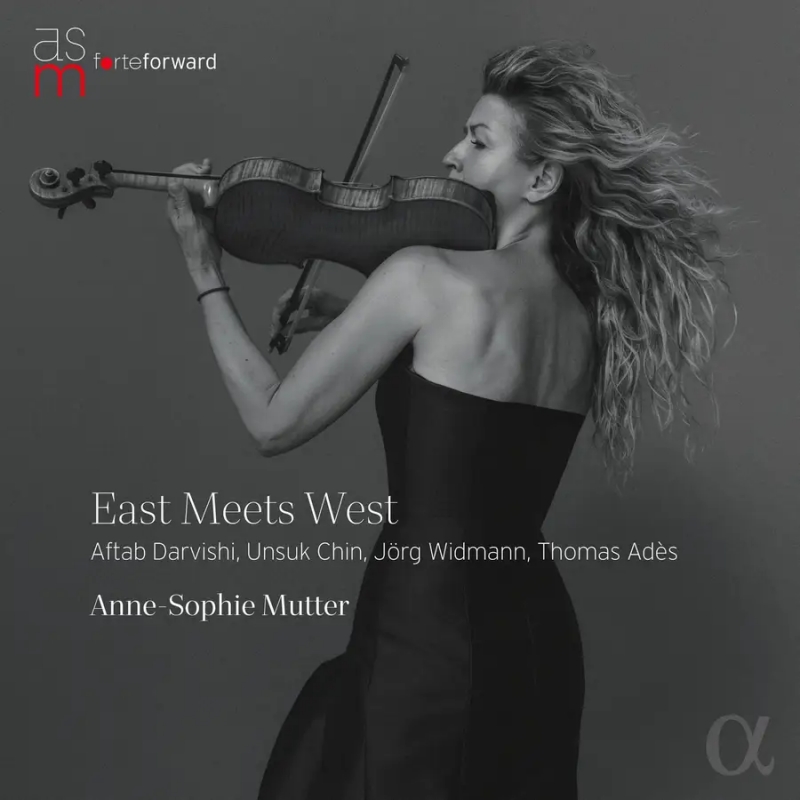
East Meets West
Aftab Darvishi, Unsuk Chin, Jörg Widmann, Thomas Adès
Anne-Sophie Mutter (violin), Nancy Zhou, Ye-Eun Choi, Muriel Razavi, Pablo Ferrández (cello), London Symphony Orchestra, Thomas Adès




發表留言