
聽見全新的「綠色」貝多芬:維京古爾的E調音樂迷宮
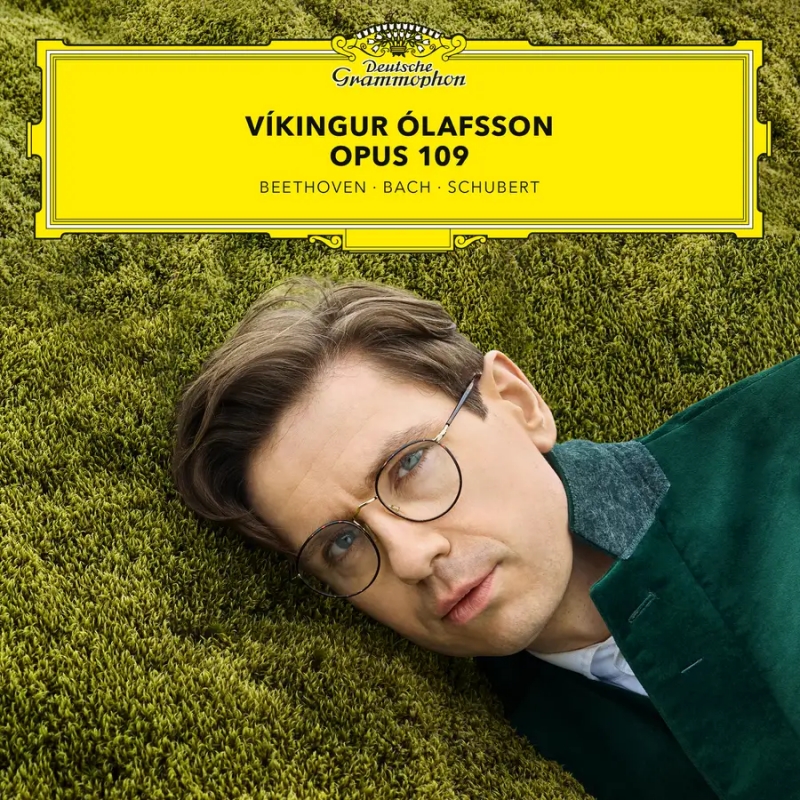
《作品109:貝多芬‧巴赫‧舒伯特》(OPUS 109)的封面很引人注意:冰島鋼琴家維京古爾(Víkingur Ólafsson)沒有坐在鋼琴前面,也沒有擺出古典巨星美照中常見的耍帥姿勢,而是穿著深綠色外套,投身在一大片綠色的冰島苔蘚中。他把耳朵貼近地面,像是在傾聽苔蘚底下細微的聲音。
這個畫面並不是視覺噱頭,而是呼應維京古爾對E大調與E小調的色彩聯想。他曾多次提到自己有類似聯覺(synesthesia)的經驗,不同調性在他腦中會呈現不同顏色,而E調始終與綠色相連。至於為什麼會有這樣的感受?他坦言目前沒有科學方法可以解釋,只能把它稱為一個「美麗的小謎團」。維京古爾把建立在E大調與E小調上的作品收進同一張專輯,讓「綠色」成為串連整張唱片的隱形線索,也讓不同作品在調性與聽覺感受之間彼此呼應。
至於側身躺在一片青綠苔蘚上的姿勢,他承認原本就是一個帶有玩心的點子,而且很享受這張封面引發的各種反應,有人覺得充滿詩意,也有人覺得古怪甚至滑稽。對他而言,不同解讀本來就是專輯想留下的空間。
反其道而行的曲目編排
對維京古爾來說,封面只是入口,真正重要的是整張專輯的曲目安排。他不只是把貝多芬、巴赫和舒伯特放在一起,而是替貝多芬的作品109設計了一條新的聆聽路線。他希望聽眾不要把這首曲子當成只能遠望的貝多芬紀念碑,而是循著E調的顏色與聲音,一步步靠近。
錄製貝多芬晚期奏鳴曲的時候,許多鋼琴家會把最後三首視為一組,因為它們就像是貝多芬晚期世界的三個入口。而維京古爾在意的,卻是另一件事:如果作品109總是排在三首作品最前面,一般人是不是很容易把它當成這組作品的「開場」?等到聽完整套作品,注意力往往被作品111終樂章的變奏吸引,忽略作品109本身的光彩。因此,這次維京古爾把作品109設定為整趟聲音旅程的核心與終極目的地,讓前面的曲目逐步為它鋪路。一路上有巴赫、另一首貝多芬奏鳴曲,加上舒伯特。共同的線索都是E調。從調性、音色到色彩聯想,他先蘊釀作品109的聲音世界,再讓它最後壓軸出現。
走向核心的前奏曲與奏鳴曲
開場的巴赫十二平均律第一冊的E大調第九號前奏曲很短,卻像是一扇門,用簡潔清楚的和聲,引領聽眾進入整張專輯的聲音世界。接著是貝多芬E小調第二十七號鋼琴奏鳴曲,作品90。這首奏鳴曲只有兩個樂章,形式簡潔,情緒卻很豐富。第一樂章充滿向前推進的力量,第二樂章則變得流暢且富歌唱性,也先讓人聽見貝多芬如何在短短兩個樂章裡,同時並容緊張感與歌唱性。
巴赫E小調第六號組曲安排在兩首E小調雙樂章奏鳴曲之間,刻意拉開兩部奏鳴曲的距離。對維京古爾而言,安排這部巴赫作品不只是調性相近,更是因為貝多芬晚期作品深受對位寫作影響。如果只把晚期貝多芬理解成情感濃烈的浪漫作品,很容易忽略其中大量襲自巴赫的寫作方式。巴赫讓我們聽見不同聲部如何彼此交織,也因此更容易導入理解作品109終樂章的變奏的發展方式。
舒伯特第六號鋼琴奏鳴曲同樣是E小調,也只有兩個樂章,因此很容易讓人聯想到貝多芬第二十七號鋼琴奏鳴曲。維京古爾也認為兩首作品之間可能存在承接關係,不過目前沒有史料證明舒伯特是以貝多芬的作品當成創作藍本,因此這仍是一種音樂上的解讀。真正重要的,不是證明誰影響了誰,而是讓我們重新比較兩首作品在結構、調性和音樂語言上的相似與相異點。
匯聚與最後的祈福
當作品109終於出現時,前面曲目所做的鋪陳:巴赫的複音、第二十七號鋼琴奏鳴曲的戲劇張力,以及舒伯特自然流動的歌唱性,都在這一刻匯聚起來。當主角,也就是作品109響起時,耳朵已經熟悉前面幾首作品的聲音,也更容易聽見它們如何在貝多芬晚期作品中交會。整首作品的情感重心落在最後一個樂章。前兩個樂章像是鋪墊,真正的旅程從變奏曲開始。貝多芬先提出一段簡單而平靜的主題,接著一次次改變它的樣貌,最後又回到最初的旋律。當熟悉的主題再次出現時,雖然旋律沒有改變,聽起來卻已經和一開始完全不同。
不過,作品109並不只是專輯的終點,而是通往最後寧靜的一道門。維京古爾最後還安排了巴赫《第六號法國組曲》的〈薩拉邦德〉作為真正的尾聲。他曾形容,這首舞曲就像一段「最後的祈福」,不是再把情緒推向高潮,而是在經歷整段旅程之後,讓聽者帶著沉澱過後的心情離開。
理性控制下的聽覺美學
維京古爾一直認為,錄音和音樂會是兩種不同的表演方式。音樂廳需要把聲音送到最後一排,錄音則可以把注意力放在細節中。所以他沒有刻意追求宏大的音響效果,而是讓每個聲部、每個音符都保持清楚的層次,也讓許多平常容易忽略的細節變得更加清晰。
不過,這樣的演奏會帶來另一種看法。當每個細節都交代得很清楚,整體聽來就可能顯得過於冷靜、工整。有些人會期待貝多芬多一點爆發力、多一點不受控制的激情。對這些聽眾而言,這樣的詮釋或許少了一點令人屏息的衝擊力。
條條大路通貝多芬
《作品109:貝多芬‧巴赫‧舒伯特》最值得聽的地方,在於它提供另一條靠近作品109的方法。一路聽下來,你聽見的不只是最後那首奏鳴曲,也會發現前面的音樂始終留在耳邊,慢慢改變你理解作品109的方式。
對初入門的聽眾而言,只要抓住兩件事:E大調與E小調的顏色變化,以及作品109到了最後,音樂如何慢慢收斂下來,從外在的起伏轉向更細微的變化。對於已經熟悉這部作品的聽眾而言,這張專輯最可貴的是它提醒我們:經典的偉大不在於它反覆被讚頌,而是每一次靠近它,都會展現不同的樣貌。
維京古爾最打動人的,不是側臥在苔蘚上的封面,也不是巧妙的曲目安排,而是他領悟到,每個人都有自己聆聽和感受貝多芬的方法。有人藉由樂譜,有人透過歷史,他則從一種顏色、一種觸感、一條繞行的遠路走近貝多芬。他改變的不是作品109,而是讓作品109暫時放下經典的光環,重新成為一首值得慢慢靠近、反覆傾聽,重新發現和理解的作品。(2026年9年15日)
譯名說明:Ólafsson不是姓氏,而是表示親子關係的父名,意為「Ólafur之子」;Víkingur才是他的本名。因此本文譯作「維京古爾」,不沿用常見的「奧拉夫森」或「歐拉夫森」。
The cover of Opus 109: Beethoven, Bach, Schubert is striking: rather than sitting at a grand piano or striking the self-conscious, stylized pose of typical classical superstars, the Icelandic pianist Víkingur Ólafsson is captured immersed in a vast, emerald field of woolly fringe moss in rural southwestern Iceland. He lies on his side with his ear pressed to the ground, as if listening intently to the microscopic, ancient whispers vibrating beneath the soil.
This image is no mere visual gimmick; it directly echoes Víkingur’s sensory associations with the keys of E major and E minor. He has frequently described his experiences of synaesthesia, a cognitive phenomenon in which different musical pitches evoke distinct visual colours in his mind. For him, the pitch of E has always been green. As for why this neurological connection exists, he admits there is currently no scientific explanation, calling it simply “a beautiful little mystery”. By compiling works written exclusively in E major and E minor, Víkingur has made “green” the invisible thread running through the entire record, allowing disparate works to converse with one another across shared tonality and acoustic space.
Regarding his physical posture of lying across the moss, he candidly confesses it was originally just “a playful thing”. He thoroughly enjoys the diverse reactions the cover has provoked—some finding it deeply poetic, others viewing it as eccentric or even comical—believing that these varied interpretations are precisely the intellectual space the album is meant to leave open.
An Unconventional Programme Design
For Víkingur, the visual cover is merely the entrance; the true substance lies in the programme’s meticulous architecture. Rather than simply juxtaposing Beethoven, Bach and Schubert, he has mapped out an entirely new listening route to Beethoven’s Sonata Op. 109. He hopes listeners will not view this masterpiece as an unapproachable, marble monument to Beethoven, but rather draw closer to its core step by step, guided by the organic colours and sounds of the key of E.
When recording late Beethoven, many pianists treat the final three sonatas (Opp. 109, 110, and 111) as an inseparable trilogy—the “three sisters”—functioning as consecutive entry points into the composer’s late creative period. Víkingur, however, was preoccupied with a different concern: if Op. 109 is always positioned at the beginning of the set, does it not risk being overshadowed as a mere “opener”? By the end of a continuous performance, a listener’s attention is inevitably captured by the cataclysmic variations in the finale of Op. 111, obscuring the unique brilliance of Op. 109 itself.
Consequently, Víkingur has positioned Op. 109 as the “gravitational centre” and ultimate destination of the entire sonic journey, allowing the preceding pieces to pave the way. Along this path run works by Bach, an earlier Beethoven sonata, and Schubert—all bound by the common thread of the key of E. Drawing on tonality, timbre and coloristic associations, he allows the acoustic world of Op. 109 to brew before the masterpiece finally emerges.
Preludes and Sonatas Paving the Way to the Centre
The album opens with Bach’s brief Prelude in E major, BWV 854, from Book I of The Well-Tempered Clavier. It acts like a doorway, its clean and luminous harmonies ushering the ear into the recording’s sonic landscape. This is followed by Beethoven’s Sonata No. 27 in E minor, Op. 90. Though deceptively compact in its two-movement structure, it is remarkably rich in affect. The first movement is driven by a restless forward momentum, while the second movement resolves into a flowing, songful melody—providing an early glimpse of how Beethoven could seamlessly juxtapose raw tension and lyrical song within a single, condensed work.
Bach’s monumental Partita No. 6 in E minor, BWV 830, is placed between the two double-movement E-minor sonatas, deliberately providing “a little distance” between them. For Víkingur, the inclusion of this monumental keyboard work goes beyond tonal affinity; it highlights how Beethoven’s late creative period was profoundly informed by Baroque counterpoint. If late Beethoven is understood solely as emotional Romanticism, one easily misses his reliance on these ancient polyphonic grammars. Bach teaches us how independent voices interweave, thus easing our entry into the contrapuntal development of Op. 109’s final movement.
Schubert’s Piano Sonata No. 6 in E minor, D 566, is likewise a two-movement work in E minor, prompting immediate comparisons with Beethoven’s Op. 90. Víkingur believes a direct lineage exists between them, though as there is no historical documentation proving Schubert used Beethoven’s sonata as a blueprint, this remains an interpretive musical reading rather than an established historical fact. What truly matters is not proving direct influence, but rather allowing us to compare the structural, tonal, and linguistic affinities and divergences of the two works.
Convergence and the Final Benediction
When Op. 109 finally arrives, the groundwork laid by the preceding pieces—Bach’s polyphony, the dramatic tension of Op. 90, and Schubert’s flowing cantabile—coalesces. By the time this focal point sounds, our ears are so attuned to the key of E that we can hear these diverse threads converge within Beethoven’s late masterpiece. The emotional gravity of the entire sonata rests on the final movement. The first two movements act as a prelude to a journey that truly begins with the theme and variations. Beethoven presents a simple, serene theme, transforms it through a series of wild adventures, and ultimately returns to the initial melody. When this familiar theme reappears, though not a single note has changed, it sounds profoundly altered to our ears.
Yet, Op. 109 is not merely the journey’s end; it is a gateway to ultimate tranquility. As a true epilogue, Víkingur places the Sarabande from Bach’s French Suite No. 6 in E major, BWV 817, at the very end. He has described this movement as a “final benediction”—a closing prayer that, rather than whipping up further emotional storms, allows the listener to depart in a state of quiet contemplation, with their thoughts fully settled.
The Auditory Aesthetics of Rational Control
Víkingur has long maintained that recording and live concert performance are entirely different art forms. While the concert hall demands projecting sound to the very back row, the studio allows the performer to “whisper secrets to the microphone,” focusing entirely on micro-details. Accordingly, he eschews massive, overwhelming acoustic weight on this album, choosing instead to preserve crystalline textures and pristine clarity for every voice and note, bringing long-overlooked details into sharp focus.
Such an approach, however, inevitably polarizes opinion. When every detail is laid bare with clinical precision, the performance can sound overly dispassionate, cool, and calculated. Listeners who expect Beethoven to burst with raw, unchecked passion and eruptive power may find this tightly controlled interpretation lacking in visceral, breathtaking impact.
All Roads Lead to Beethoven
The true value of Opus 109: Beethoven, Bach, Schubert lies in the alternative route it maps out to approach Op. 109. As you travel through the album, you do not merely hear the final sonata; you realize that the echoes of the preceding works linger in your mind, gradually transforming the way you perceive Beethoven’s late masterpiece.
For newcomers, the album can be grasped through two simple coordinates: the shifting green hues of E major and E minor, and the way Op. 109 gradually turns inward at its close, moving from grand external gestures to the most delicate, microscopic nuances. For those already deeply familiar with these works, the album offers a more profound reminder: the greatness of a classic does not lie in its passive monumentalisation, but in its capacity to shift shapes every time we draw near.
Ultimately, what is most compelling about Víkingur is neither the striking moss-covered cover nor the ingenuity of his programme, but his realization that every listener must find their own path to Beethoven. Whether one enters through the score or through history, Víkingur chooses to approach Beethoven through a specific color, a sensory touch, and a winding detour. In doing so, he does not alter Op. 109 itself, but strips away its intimidating, monumental status—transforming it once more into a living work of art to be slowly approached, repeatedly heard, and continually rediscovered.
(15 September, 2026)
Note on the name:
Ólafsson is a patronymic, while Víkingur is his given name; he is therefore referred to here as Víkingur.
Opus 109
Beethoven - Bach - Schubert
Víkingur Ólafsson (piano)
July 2025, Norðurljós Hall, Harpa Concert House, Reykjavík
 陳效真作品集
發表留言