
掌握「簡單」的分寸:利謝茨基再訪莫札特鋼琴協奏曲
二○一○年,十五歲的加拿大鋼琴家利謝茨基(Jan Lisiecki)收到一家唱片公司的簽約邀請。他希望首張專輯就錄莫札特鋼琴協奏曲,對方卻認為莫札特的市場吸引力有限,建議先錄一張集合不同作曲家作品的專輯,看看市場反應。利謝茨基沒有接受。後來與DG簽約,他仍堅持首張專輯要錄莫札特鋼琴協奏曲。於是二○一二年,利謝茨基和指揮扎哈里亞斯(Christian Zacharias)、巴伐利亞廣播交響樂團錄下第二十號與第二十一號鋼琴協奏曲。對一名剛起步的少年鋼琴家來說,這並不是最安全的首張唱片選擇。
為什麼十五歲就堅持把莫札特當成唱片的起點?我沒有找到利謝茨基直接的說法,不過,這個選擇和他後來表達的演奏觀很一致。莫札特的音樂聽來自然流暢,很少用華麗的技巧來吸引注意,卻容不得演奏者含糊帶過。只要一個樂句轉折不順,或是樂句的呼吸稍顯生硬,聽眾很快就能聽出來。快速音階很容易讓人直接感受到技巧,莫札特更難的地方,卻往往藏在樂句、呼吸、音色與各聲部的比例之中,需要演奏者有成熟穩定的判斷。因此,對當時的利謝茨基來說,以莫札特作為唱片起點,未必比炫技曲目安全,反而更容易暴露演奏上的不足。
讓音樂自己說話
相隔十一年,利謝茨基在二○二三年再次錄製莫札特鋼琴協奏曲,與何內克(Manfred Honeck)、班貝格交響樂團(Bamberger Symphoniker)合作錄下第九號與第二十二號。談到莫札特,利謝茨基曾說,他希望讓音樂自己說話,不要過度分析。我把這種態度理解為一種「簡單」。不過,他所謂的「簡單」,並不等於把演奏做得平淡。他更在意的是,不讓自己的處理搶走聽眾對作品的注意力。這張唱片最吸引我的,不只是他怎麼彈莫札特,更在於他如何控制細節,又不讓細節打斷音樂的流動,並在獨奏與樂團之間保持平衡。
利謝茨基很早便以少年鋼琴家的身分受到注意,外界也很容易把焦點放在他的年齡與技巧上。但是他談到演奏時,重點往往還是作品本身。對他而言,怎麼表現自己不是最重要的,重要的是能不能把作品表達清楚。
退後,不是消失
這種態度在第九號協奏曲的開頭聽得最清楚。樂團只演奏兩個小節,鋼琴便立刻加入。利謝茨基沒有把進場彈成搶話,而是自然接過樂團尚未說完的句子。何內克也沒有為了突出獨奏而刻意壓低樂團,鋼琴、木管與弦樂之間沒有明顯的主從關係。這裡所謂的「退後」,無關刻意壓低音量,也不表示放棄自己的處理。更重要的是,鋼琴要為與樂團的對話留下空間。
慢板的難題
第二樂章進入小調後,氣氛轉暗。利謝茨基不用濃重的踏板,也沒有刻意營造悲傷的氣氛,整體情緒始終受到控制。不過,他對速度與力度做了很多細微調整,每個樂句轉折都處理得很仔細。問題也正在這裡:細節愈清楚,有時反而愈容易把長句切成較短的單位,使旋律少了一點一氣呵成的感覺。這也正是慢速段落特別難處理的原因。鋼琴的聲音在琴槌擊弦後便開始減弱,演奏者無法像歌手一樣,把一個長音延續著唱下去。鋼琴家只能靠觸鍵、踏板,以及下一個音進來的時間,讓一個個逐漸變弱的聲音連成長句。因此,他所謂的「簡單」不等於少做,關鍵在於知道哪些處理有必要,哪些最好收回去。
何內克掌握整體方向
在這張錄音裡,何內克的重要作用,是維持鋼琴與樂團整體的方向。利謝茨基曾經從鍵盤領奏貝多芬五首鋼琴協奏曲。他認為只要樂團能主動聆聽,不一定每次都需要指揮。從鍵盤領奏雖然可以提示速度、呼吸與進場,演奏者卻同時還要處理自己的聲部,很難像站在樂團前方的指揮那樣,持續調整各聲部的比例。從錄音聽來,何內克並沒有強行把獨奏納入自己的框架,而是讓利謝茨基保有自己的演奏方式,同時替樂團維持整體的流動與各聲部的比例。
室內樂般的聆聽與對話
到了第二十二號,兩人如何在音樂上互相配合,聽得更加清楚。第二樂章的C大調變奏與第三樂章的小步舞曲插段中,弦樂編制一度縮成五重奏,鋼琴與弦樂的關係因此更接近室內樂,每條旋律線也聽得更清楚。誰先呼吸、誰調整速度和音量,其他人都能立即聽見並作出回應。利謝茨基收斂音量、減少踏板,弦樂也隨著他的呼吸調整。此時的重點不再是誰帶領誰,而是彼此聆聽,在細微的變化中一起推動音樂。
炫技也有位置
莫札特沒有為第二十二號協奏曲譜寫裝飾奏,利謝茨基採用的是巴杜拉─斯科達(Paul Badura-Skoda)的版本(第一樂章、第三樂章)。這些段落具有鮮明的炫技性,表面上似乎與他不願搶在作品前面的態度衝突。但是當樂團停下,只剩鋼琴承接前面累積的張力時,獨奏者也可以暫時站到最前面,充分展現自己。真正重要的是,炫技出現在什麼位置,又是否接得住前面累積的音樂張力。正因如此,裝飾奏也成了最能看出他如何理解「簡單」的地方。如果「簡單」只等於克制,炫技自然會顯得格格不入。但是在利謝茨基的演奏裡,「簡單」更接近知道什麼時候該多做、什麼時候該收手,因此裝飾奏裡的炫技並不矛盾。
簡單不是公式
整張唱片因此呈現利謝茨基演奏中的兩面。快速段落裡,他的觸鍵明快、音色清晰,反應很靈活;到了速度較慢的地方,他對速度和力度的細微調整,有時會讓長句顯得不夠連貫。這可能是細節處理得太密,也可能是他有意避免把慢板彈得過度柔順。真正值得問的是:對細節控制得愈多,是否反而愈難維持整體的流動?無論怎麼解讀,愈是單純的旋律,愈能聽出他什麼時候想多做一點、什麼時候選擇收手,也愈能聽出這些選擇帶來的效果。
利謝茨基並沒有把「簡單」變成固定的演奏模式。他可以從鍵盤帶領樂團,也可以與指揮緊密配合;他在多數段落都相當克制,到了裝飾奏卻也可以讓技巧充分展開。因此,他所謂的「簡單」並不等於永遠收斂,而會隨著作品、編制與合作對象調整自己的演奏方式。
在音樂裡找到位置
回頭看利謝茨基十五歲時拒絕的錄音提案,也更能理解他當年的堅持。他沒有拒絕市場,只是不願讓市場替自己決定第一張唱片應 該錄什麼。十多年後,他再次錄製莫札特,也沒有因為強調「讓音樂自己說話」,就刻意抹去自己的判斷。相反地,從速度、力度、踏板、樂句處理,到他和樂團如何配合,都能聽見他的選擇。這張唱片真正有意思的,也正是他不斷調整自己在音樂裡的位置:什麼時候應該站到前面,什麼時候應該退後,又做到什麼程度才算剛好。(2026年10月27日)
In 2010, the fifteen-year-old Canadian pianist Jan Lisiecki received a recording contract offer from a record label. He insisted that his debut album be dedicated to Mozart’s piano concertos; the label, however, believed Mozart had limited commercial appeal and suggested instead a “hodgepodge album of different pieces from different composers" to test the market, even remarking that “Mozart will never sell". Lisiecki refused. When he subsequently signed with Deutsche Grammophon (DG), he maintained his resolve to record Mozart concertos for his debut. Thus, in 2012, at the age of seventeen, Lisiecki recorded Mozart’s Piano Concertos Nos. 20 and 21 (K. 466 & K. 467) alongside conductor Christian Zacharias and the Bavarian Radio Symphony Orchestra. For an emerging teenage pianist, this was by no means the safest choice for a debut record.
Why was he so determined at fifteen to make Mozart his recording point of departure? Although Lisiecki has not addressed this directly, the choice aligns seamlessly with the artistic philosophy he later articulated. Mozart’s music sounds natural and fluid—rarely relying on flashy technique to capture attention—yet it offers the performer nowhere to hide. Should a phrase turn awkwardly or a musical breath feel slightly stiff, the listener notices instantly. Fast scalar runs readily showcase technical brilliance; Mozart’s true difficulty, however, lies concealed within phrasing, breath, timbre, and the delicate balance between voices—demanding mature, grounded judgment from the performer. For the young Lisiecki, choosing Mozart for his debut was hardly safer than a programme of showpieces; if anything, it was far more likely to expose interpretive shortcomings.
Letting the Music Speak for Itself
Eleven years later, Lisiecki returned to Mozart’s piano concertos in 2023, collaborating with conductor Manfred Honeck and the Bamberg Symphony Orchestra to record Concertos Nos. 9 (“Jeunehomme", K. 271) and 22 (K. 482). Discussing Mozart, Lisiecki once remarked that he prefers to “let the music speak for itself" rather than over-analyse it. I understand this attitude as a form of “simplicity". Yet his notion of simplicity is by no means synonymous with bland or featureless playing. What matters most to him is ensuring that his own interpretive interventions do not divert the listener’s attention from the work itself. What captivates me most about this recording is not merely how he plays Mozart, but how he meticulously controls detail without disrupting the music’s natural momentum, maintaining an exquisite equilibrium between soloist and orchestra.
Lisiecki attracted attention as a young pianist very early in his career, making it easy for the outside world to fixate on his age and technical precocity. Yet when he speaks about performance, his focus remains steadfastly on the work itself. For him, self-display is not the priority; what truly matters is whether the music is articulated with absolute clarity.
Stepping Back Is Not Disappearing
This posture is most audible at the opening of Concerto No. 9. After the orchestra plays just two bars, the piano enters immediately. Lisiecki does not treat this entry as an interruption; instead, he seamlessly picks up the sentence left unfinished by the ensemble. Nor does Honeck deliberately suppress the orchestra to project the soloist—there is no rigid hierarchy between piano, woodwinds, and strings. “Stepping back" here has nothing to do with artificially dropping one’s volume, nor does it imply relinquishing interpretive responsibility. Rather, it means the piano actively creates space for dialogue with the ensemble.
The Challenge of the Slow Movement
In the second movement, as the music shifts into the minor key, the atmosphere darkens. Lisiecki avoids heavy pedalling or engineered pathos, keeping the emotional tone rigorously under control. Nevertheless, he introduces subtle inflections in tempo and dynamics, carving every phrase turn with care. Yet here lies the predicament: the clearer the details, the easier it becomes to fragment long-spanned phrases into smaller units, slightly compromising the sense of a single, unbroken arc. This illustrates why slow movements are notoriously challenging on the piano. Once a hammer strikes the string, the piano sound inevitably decays; a pianist cannot sustain a long note with continuous breath as a singer can. The player must rely entirely on touch, pedalling, and the precise timing of subsequent notes to connect fading sounds into a singing line. Thus, Lisiecki’s “simplicity" is not about doing less; the key lies in discerning which interventions are necessary and which are better withheld.
Honeck Shaping the Overall Direction
In this recording, Manfred Honeck’s crucial role is maintaining the overall trajectory of piano and orchestra together. Lisiecki previously directed all five Beethoven piano concertos from the keyboard, reflecting his belief that “when working with exceptional orchestral musicians who listen actively and collaborate, a conductor is not always necessary". While play-conducting allows the soloist to cue tempo, breath, and entries directly, the player must simultaneously handle their own complex solo part, making it difficult to continuously balance orchestral voicings the way a conductor standing in front of the ensemble can. On this recording, Honeck does not force the soloist into a rigid mould; instead, he allows Lisiecki to retain his individual style while safeguarding the orchestra’s overarching momentum and balance of voices.
Chamber-like Listening and Dialogue
By Concerto No. 22, the musical interplay between the two becomes even more transparent. In the C major variations of the second movement, the string section contracts to a solo quintet. Consequently, the relationship between piano and strings approaches that of chamber music, rendering every melodic line pristine. Whichever musician breathes first or adjusts tempo and dynamic is heard instantly by the others and answered in kind. As Lisiecki reduces his volume and pedal, the strings adjust fluidly to his breath. The focus is no longer on who leads whom, but on mutual listening—propelling the music forward through subtle, shared nuances.
A Place for Virtuosity
Mozart left no original cadenzas for Concerto No. 22, and Lisiecki chooses those written by Paul Badura-Skoda. These passages possess an unmistakable virtuosity that might appear, on the surface, to contradict his reluctance to place himself ahead of the music. Yet when the orchestra falls silent, leaving the piano to inherit the accumulated tension, the soloist is entitled to step briefly to the fore and express himself fully. What truly matters is where virtuosity appears and whether it sustains the accumulated musical energy In this sense, the cadenzas reveal most clearly how Lisiecki conceives “simplicity". If simplicity meant mere self-restraint, virtuosity would inevitably feel out of place. But in Lisiecki’s playing, simplicity is closer to knowing precisely when to expand and when to hold back—making the virtuosity within the cadenzas entirely harmonious.
Simplicity Is Not a Formula
The recording thus reveals two complementary facets of Lisiecki’s art. In fast passages, his touch is crisp, his tone luminous, and his responsiveness nimble; in slower sections, his delicate adjustments of tempo and dynamics occasionally make long phrases feel slightly fragmented. This may stem from an over-density of detail, or perhaps from a conscious effort to avoid over-smoothing the Andante. The question worth asking is this: does an increased control over detail make it harder to sustain the overall flow? Whichever way one interprets it, the simpler the melody, the clearer it becomes when he chooses to do a little more, when he chooses to hold back, and what effects those choices produce.
Lisiecki has not turned “simplicity" into a rigid formula. He can direct an orchestra from the keyboard or collaborate intimately with a conductor; he remains disciplined through most passages, yet allows his technique full rein in the cadenzas. Thus, his idea of simplicity does not mean perpetual understatement, but an approach that adapts fluidly to the work, the instrumentation, and his musical partners.
Finding One’s Place Within the Music
Reflecting on the recording proposal Lisiecki rejected at fifteen makes his early stance all the more intelligible. He was not rejecting the market; he was simply unwilling to let the market dictate what his first record should be. More than a decade later, in returning to Mozart, he has not erased his own judgment in the name of “letting the music speak for itself". On the contrary, from tempo, dynamics, and pedalling to phrasing and his rapport with the orchestra, every choice bears his distinct imprint. What makes this recording genuinely compelling is how he continually recalibrates his place within the music: knowing when to step forward, when to recede, and exactly how much is just enough. (27 October, 2026)
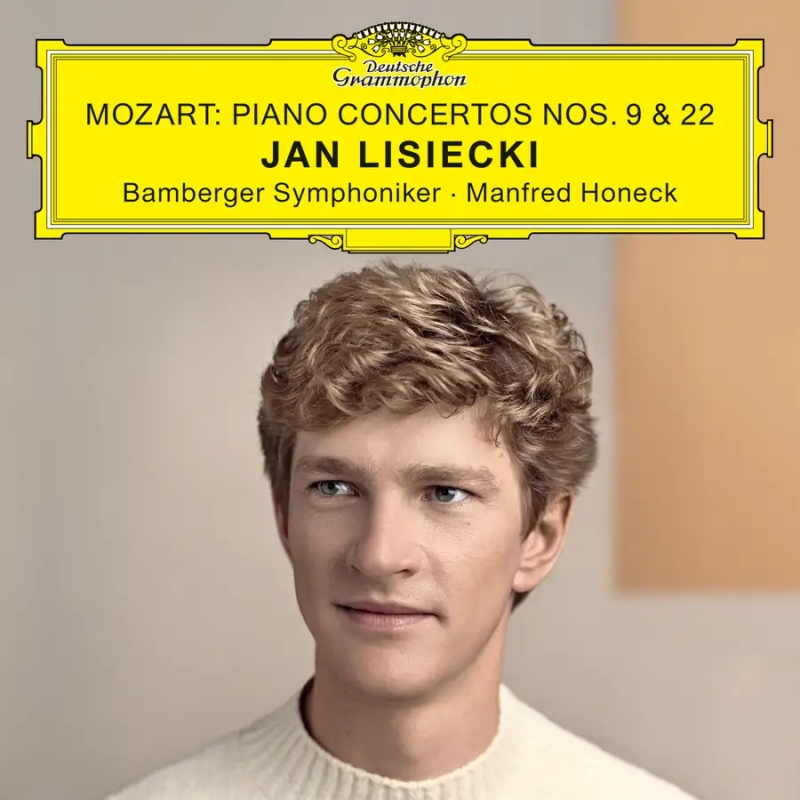
MOZART Piano Concertos Nos. 9, 22
Jan Lisiecki (piano), Bamberger Symphoniker, Manfred Honeck
November 2023, Joseph-Keilberth-Saal Bamberg


發表留言