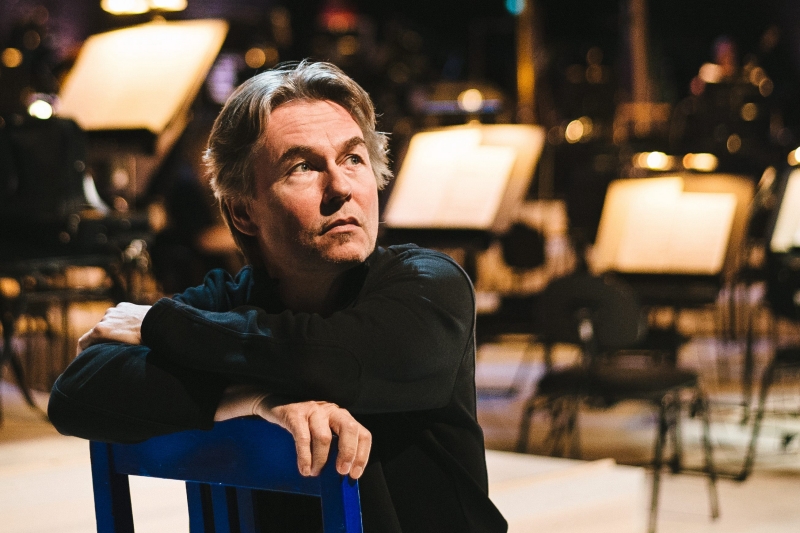
身兼指揮與作曲家的薩隆納(Esa-Pekka Salonen),作品以精準的聲響設計與細膩的配器見長。《給管風琴與管弦樂團的協奏交響曲》(Sinfonia concertante for organ and orchestra)的誕生,源於巴黎聖母院管風琴家拉特里(Olivier Latry)長達十年的期待。他深信,以薩隆納精湛的管弦樂配器技巧,如果能結合管風琴的音栓運用,必定能產生理想的聲響效果。因此,他主動邀請薩隆納為管風琴與樂團寫一首新作。不過,薩隆納一開始很猶豫,甚至直接反問:「管風琴加上管弦樂團,這不會變成一團巨大的噪音嗎?」
Esa-Pekka Salonen, a conductor and composer, is known for his precise acoustic designs and delicate orchestration. The creation of his "Sinfonia concertante" stemmed from the decade-long anticipation of Olivier Latry, the organist at Notre-Dame de Paris. Latry firmly believed that combining Salonen’s masterful orchestration skills with the use of organ registration would produce an ideal acoustic effect. Therefore, he actively invited Salonen to write a new piece for organ and orchestra. However, Salonen was initially hesitant, even asking directly: "The organ and the orchestra, what kind of racket is that going to make?" (« l'orgue et l'orchestre, qu'est-ce que ça va faire comme boucan ? »).

In terms of pitch, dynamic range, and tonal variation, the organ itself is fully capable of covering, and even exceeding, the scale of an entire symphony orchestra. Salonen wondered: if he were to write for two sound bodies that are essentially both as massive as an "orchestra", would it just be a meaningless acoustic replication, like placing "cake upon cake"? It was exactly this doubt over redundancy that forced Salonen to rethink how to compose this piece so that it would not just be throwing two giants together. For this, he even admitted that he was "tearing my hair out" in distress!

Structure: A Chameleon-like Sinfonia concertante

Salonen pondered for a long time and finally found a crucial solution: temporarily avoiding assigning a specific phrase to a particular instrument, but rather writing down the abstract musical lines and content first, and then figuring out how the organ and the orchestra could complement each other. As a result, he abandoned the traditional concerto format of "soloist versus orchestra." This is also exactly why the piece was named "Sinfonia concertante".

During this approximately 30-minute musical journey, the organ constantly changes its role with "chameleon-like flexibility". Sometimes it acts as a soloist, sometimes it engages in a chamber music-like dialogue with the woodwinds; and at certain moments, it completely blends into the orchestra, becoming a supporting member of the collective. To let this flow happen naturally, Salonen deliberately blurred the acoustic boundaries between the two in his orchestration, making it sometimes difficult to tell whether the sound comes from the organ or the orchestra. When the sounds are woven together most intricately, the composer himself admitted: "In fact, there are some moments, where I am not even sure myself, where exactly the flutes fade out and the organ fades in".

Practice: The Alchemy of Tone Colour

After resolving the structural issues of the piece, the real challenge began: how could the sounds of the organ and the orchestra seamlessly merge? The difficulty first came from the organ's own sound production mechanism. Latry pointed out that a symphony orchestra is "always alive", while the organ is a massive, precise "machine" with discontinuous movements. For instance, it lacks a sustain pedal like that of a piano; as soon as the hands leave the keyboard, the sound stops immediately. Therefore, the continuity of the music must rely on extremely delicate finger control.

Salonen tried to use highly precise musical lines to allow this mechanical instrument "to make it flexible with form", approaching the flow of an orchestra. However, during the performance, what truly dictates the tonal changes is how the performer selects and combines the stops. Latry described this process as being "like alchemy in some ways. You're making gold out of the other metals". He also likened it to "a cook in a big restaurant having all of those things and knowing exactly what you will put just to make that tasty". This means the performer must choose from thousands of pipes to accurately combine the appropriate sound.

Among them, the most crucial tool is the extensive use of "mutation stops". These stops do not produce the fundamental pitch when played, but rather overtones such as fifths, thirds, or even sevenths. Salonen specifically valued the special effects brought by these complex overtones. He also confessed that some combinations would produce highly unusual sounds, even making people feel it is slightly "out of tune". Yet, it is exactly this texture between stability and instability that gives the organ's tone more than just heaviness, adding a touch of shimmer and fluidity. Therefore, apart from volume and layers, listeners can also pay special attention to those slightly shifting and shimmering tonal changes.

Variables: The Unique Acoustic Space of Weiwuying

When performing the "Sinfonia concertante", the most unpredictable variables come from the instrument and the space. As Salonen noted, "there are no two similar organs on this planet"; even if the principles of using the stops are marked as detailed as possible in the score, the actual sound will still differ due to the instrument and the environment. Consequently, Salonen gave up the idea of "absolute control" over the final result, leaving the ultimate acoustic presentation to be determined jointly by the performer and the spatial conditions, even leaving space for the organist to improvise their own cadenza in the score.

The organ used for this performance in Kaohsiung was built by the German manufacturer Klais Orgelbau, commissioned by Weiwuying. Ranking among the largest in Asia, it boasts over 9,000 pipes and 127 stops. More uniquely, this system is divided into two parts: the Symphonic Organ with a French Romantic character on the upper left side of the stage, and the Echo Organ leaning towards a German Baroque style on the right. This means the performer can simultaneously command two sonic resources with entirely different personalities, achieving delicate combinations and balances through a mobile console. This process is extremely refined and complex, impossible to replicate exactly in other venues. For the audience, this means every live performance will be an absolutely unique sonic experience.

Conclusion: A Sonic Dialogue Across Time

In addition to acoustic experiments, Salonen also brought medieval music into the modern soundscape. In the early stages of composition, he asked Latry: "what is the oldest piece in the organ repertoire?" (« quelle est la pièce la plus ancienne du répertoire pour orgue »). Ultimately, in the third movement, Salonen quoted "Viderunt omnes" by the late 12th-century Notre-Dame composer Pérotin. This ancient melody was re-orchestrated and woven into modern symphonic language, connecting the sound of a contemporary concert hall with the acoustic memories of a medieval cathedral.

Facing such a massive and complex work, Salonen offered a relaxed yet practical piece of advice for listening: "Don't try too hard, just sit there and let it happen. And if your mind starts to wander, that's fine". To him, listening to music is less about trying to grasp everything and more about surrendering oneself to the process of sound. It is just "like a kid in the candy shop", simply attracted by various novel sounds, freely and happily exploring them. If this pure and direct joy can be transmitted to the listeners, he would already be satisfied. (23 June, 2026)




發表留言